
When your reflection reveals subtle hollows where youthful fullness once lived, understanding the strategic difference between cheek and temple fillers becomes essential to achieving natural facial harmony. These two face-framing techniques work in complementary yet distinct ways—one restoring midface structure while the other softens the upper face’s contours.
At Modern Aesthetic Institute in Bakersfield, Dr. Joseph H. Chang approaches facial volume restoration with the precision of a UCLA-trained oculoplastic surgeon and the artistry of a master injector. With over 25 years of aesthetic medicine experience, Dr. Chang recognizes that the question isn’t simply “which filler?” but rather “which area addresses your specific aging pattern?”
Understanding how cheek and temple fillers differ—and work together—can transform your approach to facial rejuvenation. Let’s explore these face-framing techniques and help you discover which path suits your aesthetic goals.
Understanding Facial Volume Loss: Where Time Shows First
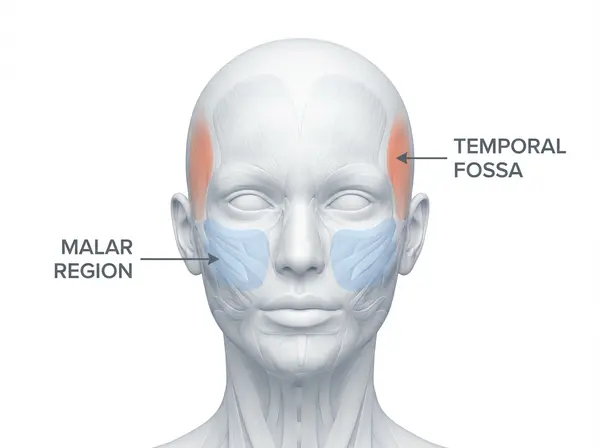
Facial aging isn’t a uniform process. Volume depletion occurs in predictable patterns, with certain areas showing change earlier than others. According to research published in the Journal of the American Medical Association, age-related midface volume loss begins as early as the late twenties, progressively affecting the temples, cheeks, and periorbital regions JAMA Facial Plastic Surgery.
The temples typically lose volume first, creating a hollowed appearance that subtly ages the entire face. This temporal hollowing occurs as subcutaneous fat pads thin and bone resorption alters the underlying facial architecture. Meanwhile, the midface—specifically the cheek area—experiences volume loss that contributes to nasolabial fold deepening and jowl formation.
In Bakersfield’s sunny climate, environmental factors compound these natural aging processes. Sun exposure accelerates collagen degradation, while lifestyle factors like stress and nutrition influence how quickly facial fat compartments diminish. Recognizing these patterns helps determine whether temple fillers, cheek fillers, or a combination approach offers optimal results.
Cheek Fillers: The Foundation of Midface Architecture
What Cheek Fillers Address
Cheek fillers—often referred to as midface volumization—target the malar region where facial fullness naturally resides in youth. This area spans from just below the lower eyelid to the top of the nasolabial fold, encompassing the apple of the cheek and the zygomatic arch.
When strategically placed, cheek fillers accomplish several aesthetic objectives:
- Restore anterior projection that diminishes with age
- Lift sagging skin in the lower face through structural support
- Soften nasolabial folds by addressing their root cause (midface deflation)
- Create definition along the cheekbone for enhanced facial contours
- Improve under-eye hollows through indirect volumization
Dr. Chang typically uses hyaluronic acid fillers like Juvéderm Voluma XC or Restylane Lyft for cheek augmentation. These FDA-approved products offer the viscosity and lifting capacity needed for deep structural placement, while maintaining natural movement and feel.
The Technical Approach to Cheek Augmentation
Effective cheek filler placement requires understanding the face’s three-dimensional anatomy. The midface contains multiple fat compartments separated by fibrous septae. Strategic injection into specific compartments—particularly the deep medial cheek fat and the superficial fat above the malar prominence—creates natural-looking volume without overfilling.
Dr. Chang’s approach incorporates vertical and horizontal vectors to achieve comprehensive midface support. By placing filler along the zygomatic eminence and extending laterally toward the temporal region, he creates a smooth transition that appears authentically youthful rather than artificially augmented.
The results from cheek fillers typically last 12-18 months, though individual metabolism, lifestyle factors, and the specific product used influence longevity. Patients in Bakersfield appreciate that maintenance treatments can often use smaller volumes once initial correction establishes the desired structure.
Temple Fillers: The Often-Overlooked Face Framer
Why Temple Volume Matters
Temple hollowing remains one of the most underappreciated signs of facial aging. The temporal region—the slightly concave area between your outer eyebrow and hairline—serves as a crucial frame for your entire face. When temporal fat pads thin with age, the resulting hollow creates shadows that make the forehead appear more prominent and the face look narrower.
Recent clinical studies demonstrate that hyaluronic acid fillers are both safe and effective for temple volumization, with results lasting at least 12 months in 98% of subjects Journal of Drugs in Dermatology. This evidence supports temple filler as a valuable tool in comprehensive facial rejuvenation.
What Temple Fillers Accomplish
Temple filler serves multiple aesthetic functions beyond simply filling a hollow:
- Restores facial balance by softening the transition from forehead to cheek
- Provides subtle brow lift through structural support of the lateral brow
- Softens harsh angles that can make features appear more masculine or aged
- Creates heart-shaped facial contours associated with youthfulness
- Reduces eye area fatigue by opening the lateral orbital region
For Bakersfield patients, Dr. Chang emphasizes that temple fillers work particularly well when combined with other treatments. The temples frame everything else—when properly volumized, they enhance the results of cheek fillers, Dysport treatments around the eyes, and even eyelid surgery by creating harmonious proportions.
The Precision Required for Temple Augmentation
Temple filler injection demands exceptional anatomical knowledge and technical skill. This region contains critical vascular structures, including branches of the superficial temporal artery and the sentinel vein. Inadvertent intravascular injection—though rare with experienced injectors—can cause serious complications.
Dr. Chang’s expertise as an ophthalmologist with subspecialty training in oculoplastic surgery provides unique advantages. His intimate knowledge of periorbital anatomy, combined with His 25+ years of injectable experience, ensures both safety and aesthetic excellence.
The ideal temple filler possesses specific characteristics: sufficient viscosity for structural support, smooth integration into surrounding tissue, and minimal tendency toward visible irregularities. Products like Juvéderm Voluma XC excel in this application due to their cohesive gel matrix and proven safety profile.
7 Key Differences: Cheek Filler vs. Temple Filler

1. Anatomical Target Zone
Cheek Fillers: Target the malar and submalar regions, addressing the midface from the lower eyelid to the upper nasolabial fold. Injection depth varies from deep periosteal placement for structural support to more superficial positioning for contour refinement.
Temple Fillers: Focus on the temporal fossa—the depression between the lateral orbital rim and the temporal line. Placement typically occurs in the deep subcutaneous plane or immediately above the temporalis fascia to ensure smooth results.
2. Primary Aesthetic Goal
Cheek Fillers: Restore youthful anterior projection and create definition along the cheekbone. The primary goal centers on midface lifting and volumization that indirectly addresses lower face aging.
Temple Fillers: Soften facial contours and restore balanced proportions to the upper face. The emphasis lies in creating smooth transitions and subtle face-framing rather than dramatic augmentation.
3. Volume Requirements
Cheek Fillers: Generally require 1-3 syringes per side for initial correction, depending on the degree of volume loss and desired projection. Maintenance treatments typically use less volume once structural support is established.
Temple Fillers: Usually need 1-2 syringes per side initially. The temporal region requires less volume than the cheeks but demands precise distribution to avoid visible irregularities or an overfilled appearance.
4. Visual Impact
Cheek Fillers: Create noticeable yet natural enhancement when properly placed. Results include lifted cheeks, softened nasolabial folds, and improved facial contours that photographs capture clearly.
Temple Fillers: Produce subtle transformation that others perceive as general rejuvenation rather than specific augmentation. The effect appears more like “you look rested” than “you had work done.”
5. Treatment Complexity
Cheek Fillers: Require advanced understanding of midface anatomy and fat compartmentalization. Technique complexity varies based on whether treatment addresses the apex, body, or lateral cheek region.
Temple Fillers: Demand expert-level anatomical knowledge due to critical vascular structures in the temporal region. The risk-to-benefit ratio necessitates a highly experienced injector.
6. Ideal Candidate Profile
Cheek Fillers: Best suit patients with midface deflation, deep nasolabial folds, loss of cheekbone definition, or desire for enhanced facial contours. Age typically ranges from late thirties onward, though some younger patients seek augmentation for naturally flat midfaces.
Temple Fillers: Ideal for patients with visible temporal hollowing, excessively angular faces, lateral brow descent, or those seeking comprehensive full-face rejuvenation. Often benefits patients from late thirties through seventies.
7. Complementary Treatment Synergy
Cheek Fillers: Work synergistically with under-eye filler (tear trough treatment), lower face fillers, and neuromodulators like Dysport. Creating midface support amplifies these adjacent treatments’ effectiveness.
Temple Fillers: Complement forehead and glabella Dysport treatments, cheek fillers for full-face balance, and even blepharoplasty by creating softer upper face contours that harmonize with refreshed eyes.
When to Choose Cheek Fillers, Temple Fillers, or Both
Choose Cheek Fillers When:
You notice flattening of your cheekbones, deepening nasolabial folds, or loss of that youthful “apple” in your cheeks. Cheek fillers excel at creating midface structure and indirectly lifting the lower face. If your primary concern involves the area from your eyes to your mouth, cheek volumization likely offers the most dramatic improvement.
Bakersfield professionals in their forties and fifties often discover that cheek fillers provide remarkable rejuvenation without the downtime of surgical options. The treatment addresses the structural changes driving visible aging rather than simply filling individual lines.
Choose Temple Fillers When:
Your temples appear sunken compared to your forehead, creating harsh angles or making your face look narrower. Temple hollowing often contributes to an aged or gaunt appearance that many don’t initially recognize as the source of their concerns.
Dr. Chang frequently recommends temple fillers for patients who feel they look tired or angular, especially those with naturally slender faces or significant weight loss. In Bakersfield’s active community, where many residents maintain fitness routines, temple hollowing from low body fat percentage is surprisingly common.
Choose Both When:
Comprehensive facial rejuvenation benefits from addressing multiple areas simultaneously. Combining cheek and temple fillers creates harmonious proportions and natural-looking results that isolated treatment cannot achieve. The temples frame the face while the cheeks provide central structure—together, they restore balanced youthfulness.
This combination approach particularly benefits patients experiencing advanced volume loss or those seeking significant transformation. During your consultation at Modern Aesthetic Institute, Dr. Chang evaluates your facial anatomy holistically, identifying which areas require attention to achieve your aesthetic goals.
What to Expect: The Treatment Experience in Bakersfield

Your Consultation with Dr. Chang
Every filler treatment at Modern Aesthetic Institute begins with comprehensive consultation. Dr. Chang examines your facial structure, discusses your concerns, and educates you about realistic outcomes. His philosophy emphasizes natural enhancement rather than dramatic alteration—you’ll leave looking like the best version of yourself, not an obviously treated version.
During consultation, Dr. Chang may use digital imaging to illustrate how cheek or temple fillers could enhance your features. This visual tool helps you understand the proposed treatment and feel confident in your decision. Many Bakersfield patients appreciate this collaborative approach that respects their autonomy while providing expert guidance.
The Injection Process
Cheek and temple filler treatments typically take 30-45 minutes, depending on whether one or both areas receive treatment. Dr. Chang uses topical anesthetic and incorporates filler products containing lidocaine for patient comfort. Most patients describe the sensation as pressure rather than pain.
The injection technique matters enormously. Dr. Chang employs cannula-based injection when appropriate, threading a blunt-tipped instrument through a single entry point to deposit filler along multiple planes. This approach minimizes puncture sites, reduces bruising risk, and allows for more precise filler placement compared to multiple needle injections.
Immediate Aftermath and Recovery
You’ll notice volume enhancement immediately, though initial swelling may exaggerate the effect for a few days. Most Bakersfield patients return to work the same day or next morning, though social events are best scheduled after any minor bruising resolves (typically 3-7 days).
Dr. Chang provides detailed aftercare instructions, including avoiding strenuous exercise for 24 hours, limiting facial massage, and sleeping with elevated head position for the first night. Following these guidelines optimizes your results and minimizes complication risks.
Safety Considerations: Why Expertise Matters
Both cheek and temple regions contain vascular anatomy that demands respect. While serious complications remain rare with experienced injectors, the temples present particular risk due to the superficial temporal artery’s course through the treatment area.
Research published in Frontiers in Surgery emphasizes that leveraging anatomical knowledge significantly improves safety and efficacy in temple augmentation Frontiers in Surgery. This underscores the importance of selecting an injector with comprehensive anatomical training and extensive experience.
Dr. Chang’s background as an ophthalmologist with fellowship training at UCLA’s Jules Stein Eye Institute provides exceptional preparation for facial filler injection. His daily work involves microsurgical procedures around delicate eye structures—precision and safety are foundational to his practice, not afterthoughts.
When you choose Modern Aesthetic Institute for your cheek or temple filler treatment, you’re selecting a provider whose qualifications exceed most cosmetic injectors. Dr. Chang’s reflects not only volume but the consistent, natural results that drive patient loyalty and word-of-mouth referrals throughout Bakersfield and Kern County.
Longevity and Maintenance: Planning Your Timeline
How Long Results Last
Cheek fillers typically maintain their volumizing effect for 12-18 months, with some patients experiencing results beyond two years. Temple fillers demonstrate similar longevity, with studies showing persistence of correction for at least 12 months in the vast majority of patients.
Individual factors influence how long your results endure:
- Metabolism: Faster metabolic rates break down hyaluronic acid more quickly
- Activity level: High-intensity exercise may accelerate filler degradation
- Injection depth: Deeper placement generally lasts longer than superficial
- Product selection: Different filler formulations offer varying longevity profiles
- Treatment area: Temple fillers may last longer due to minimal muscle movement
Maintenance Strategy
Dr. Chang typically recommends scheduling maintenance treatments before complete filler dissolution. This proactive approach maintains your results with less product than required for initial correction. Many Bakersfield patients establish annual or bi-annual treatment schedules that fit naturally into their self-care routines.
The investment in maintenance proves worthwhile when you consider the cumulative benefit. Each treatment builds upon previous results, and maintaining volume prevents the accelerated aging that occurs when structural support completely disappears.
Cost Considerations: Investing in Natural Enhancement
Discussing cost candidly helps you plan appropriately for your aesthetic goals. At Modern Aesthetic Institute, cheek and temple filler pricing reflects the premium products used, Dr. Chang’s expertise, and the comprehensive care provided.
Cheek filler treatment typically requires 2-6 syringes total (both sides combined) for initial correction, depending on your baseline volume and desired enhancement. Temple fillers usually need 2-4 syringes total. When combining treatments, package pricing may offer value compared to addressing areas separately.
While specific pricing varies based on your individualized treatment plan, most patients find that the confidence and satisfaction derived from natural-looking results far exceed the financial investment. Dr. Chang’s honest assessment prevents overtreatment—he’ll recommend only what genuinely benefits your appearance, potentially saving you money compared to providers who prioritize volume over artistry.
Modern Aesthetic Institute accepts various payment methods and can discuss financing options during your consultation. Many Bakersfield patients appreciate that investing in expert care initially costs less than correcting poorly executed treatments later.
Alternative and Complementary Treatments
Fat Grafting: The Permanent Option
For patients seeking longer-lasting volume restoration, autologous fat transfer offers an alternative to hyaluronic acid fillers. This surgical procedure harvests fat from one body area and transplants it to the cheeks or temples.
Fat grafting provides permanent results (once transferred fat establishes blood supply) and creates exceptionally natural contours. However, it requires surgical recovery, involves some unpredictability in fat survival rates, and necessitates having adequate donor fat available. Dr. Chang can discuss whether this option aligns with your goals during consultation.
Sculptra: The Collagen Stimulator
Sculptra (poly-L-lactic acid) works differently than traditional fillers by stimulating your body’s collagen production over several months. This gradual approach creates subtle, natural-looking volume enhancement that can last two years or longer.
Sculptra excels at treating widespread volume loss but requires multiple treatment sessions and patience as results develop gradually. Some Bakersfield patients prefer this progressive enhancement, while others want the immediate gratification hyaluronic acid fillers provide.
The Comprehensive Approach
Many patients achieve optimal results by combining filler treatments with complementary procedures:
- Dysport or Botox: Relaxes muscles causing wrinkles, creating smooth canvas for filler
- Chemical peels: Improves skin texture and tone to match restored volume
- IPL photofacial: Addresses sun damage and pigmentation common in Bakersfield
- Microneedling with PRP: Enhances skin quality and filler integration
- Eyelid surgery: Addresses excess skin that fillers cannot correct
Dr. Chang’s comprehensive aesthetic approach considers how various treatments work synergistically. Your consultation explores not just immediate concerns but long-term aesthetic strategy that adapts as your needs evolve.
Real Patient Perspectives: What to Actually Expect
While we don’t include before-and-after photos here (visit our Bakersfield office to view Dr. Chang’s extensive portfolio), patient testimonials illuminate the treatment experience better than clinical descriptions alone.
Patients consistently describe Dr. Chang as “the Michelangelo of b-tox” and note his exceptional attention to detail. They appreciate his willingness to say “no” when a requested treatment wouldn’t benefit their appearance—honesty that builds trust and prevents overtreatment.
Many Bakersfield residents specifically mention Dr. Chang’s patient communication style. He explains what he’s doing during treatment, making the experience less intimidating for first-time patients. His high energy and kind demeanor, combined with genuine expertise, create an atmosphere where patients feel cared for rather than processed.
The consistent theme in patient feedback centers on natural results. Friends and colleagues notice these patients look refreshed and rested but can’t identify what changed. This subtle enhancement aligns perfectly with Dr. Chang’s philosophy of revealing your natural beauty rather than creating an obviously artificial appearance.
Making Your Decision: Questions to Ask
Before committing to cheek or temple filler treatment anywhere in Bakersfield or Kern County, consider asking potential providers:
- What specific training qualifies you for facial filler injection? Look beyond basic certification to fellowship training, medical specialty, and ongoing education.
- How many temple filler treatments do you perform annually? Volume matters—experience with the specific treatment area reduces complication risks.
- What products do you recommend and why? Quality providers use FDA-approved products and can explain their selection rationale.
- How do you handle complications should they occur? Understanding emergency protocols and access to reversal agents (hyaluronidase) indicates preparedness.
- Can I see examples of your work on patients similar to me? Reviewing results on your age, ethnicity, and facial structure provides realistic expectations.
- What is your aesthetic philosophy? Ensure alignment between your goals and the provider’s approach (natural enhancement vs. dramatic transformation).
These questions help identify practitioners who prioritize safety, possess appropriate expertise, and share your aesthetic sensibility—all essential factors in achieving satisfying results.
Why Choose Modern Aesthetic Institute for Face-Framing Fillers
Selecting where to receive cheek or temple filler treatment represents one of the most important decisions in your aesthetic journey. Modern Aesthetic Institute offers distinct advantages that set Dr. Chang apart from other Bakersfield providers:
Unparalleled Qualifications: training in ophthalmology with subspecialty fellowship training in oculoplastic surgery provides anatomical expertise few cosmetic injectors possess. Dr. Chang’s surgical background informs his injection technique, ensuring both precision and safety.
Proven Track Record: Dr. Chang’s 25+ years of injectable experience reflects consistent results that drive patient loyalty and referrals. Volume stems from quality—patients return and recommend Dr. Chang because their outcomes exceed expectations.
Honest Guidance: Dr. Chang’s willingness to recommend against treatments that wouldn’t benefit you demonstrates integrity rare in aesthetics. His philosophy prioritizes your long-term satisfaction over short-term revenue.
Comprehensive Care: Treatment at Modern Aesthetic Institute extends beyond the injection itself. Pre-treatment education, meticulous technique, appropriate follow-up, and accessibility for questions create an experience focused entirely on your wellbeing and results.
Bakersfield Connection: Dr. Chang has served the Bakersfield community for over 20 years, establishing relationships built on trust and exceptional care. He understands the lifestyle, climate, and aesthetic preferences of Kern County residents.
When you’re ready to explore how cheek or temple fillers could enhance your natural beauty, Modern Aesthetic Institute provides the expertise, artistry, and patient-centered care you deserve.
Take the Next Step Toward Natural Volume Restoration
Understanding the difference between cheek and temple fillers empowers you to make informed decisions about facial rejuvenation. Whether you’re just beginning to notice volume loss or seeking comprehensive enhancement, Dr. Joseph H. Chang’s expertise guides you toward results that honor your unique facial architecture.
At Modern Aesthetic Institute in Bakersfield, we believe aesthetic treatments should reveal—not conceal—who you truly are. Cheek and temple fillers, when artfully placed by experienced hands, restore the youthful vitality that reflects how you feel inside.
Ready to discover which face-framing technique suits your goals? Schedule your personal consultation with Dr. Chang today. Together, we’ll create a customized treatment plan that celebrates your natural beauty while addressing the specific concerns bringing you to our practice.
Your journey toward natural facial harmony begins with a conversation. Contact Modern Aesthetic Institute in Bakersfield to schedule your consultation and experience the difference expert care makes.
ABOUT THE AUTHOR
Dr. Joseph H. Chang is an ophthalmologist specializing in oculoplastic surgery with over 25 years of aesthetic medicine experience serving Bakersfield and Kern County. Trained at UCLA’s prestigious Jules Stein Eye Institute, Dr. Chang brings surgical precision and artistic sensibility to every dermal filler treatment. His 25+ years of injectable experience reflects his expertise and the trust patients place in his care. At Modern Aesthetic Institute, Dr. Chang’s philosophy centers on natural enhancement, patient education, and honest guidance—helping you achieve softened nasolabial folds and restored youthful contours through strategic midface volumization that honors your unique facial architecture.
FREQUENTLY ASKED QUESTIONS
Q: How do I know if I need cheek filler, temple filler, or both?
A: The best way to determine your ideal treatment involves comprehensive facial analysis with an experienced injector like Dr. Chang. During consultation, he evaluates your specific volume loss patterns, facial proportions, and aesthetic goals. Generally, if you notice midface flattening and deepening nasolabial folds, cheek fillers likely benefit you most. Visible temple hollowing or a narrow, angular upper face suggests temple fillers. Many patients achieve optimal results addressing both areas for balanced rejuvenation.
Q: Are cheek and temple fillers painful?
A: Most patients experience minimal discomfort during cheek and temple filler treatments. Dr. Chang uses topical anesthetic before injection, and the filler products contain lidocaine for additional numbing. Many describe the sensation as pressure rather than pain. Temple treatment may be slightly more sensitive than cheeks due to thinner tissue in that region, but remains well-tolerated by the vast majority of patients.
Q: How long before I see final results from my filler treatment?
A: You’ll notice volume enhancement immediately after treatment, though initial swelling may exaggerate the effect for 3-7 days. Final results become apparent once swelling completely resolves, typically within two weeks. The filler integrates naturally during this period, and you’ll see how the volume enhancement looks in various lighting and facial expressions. Dr. Chang schedules follow-up appointments to evaluate your results and determine if any touch-up treatment would refine the outcome.
Q: Can temple fillers help with a drooping brow?
A: Temple fillers provide subtle structural support that can gently lift the lateral (outer) brow area. While not as effective as surgical brow lift for significant descent, temple volumization addresses the hollowing that makes brows appear heavier. Many Bakersfield patients appreciate this gentle lifting effect, especially when combined with strategic Dysport placement. Dr. Chang evaluates your specific anatomy to determine realistic expectations for brow position improvement through temple augmentation.
Q: What’s the difference between temple filler and cheek filler products?
A: Temple and cheek fillers often use the same product families—typically robust hyaluronic acid fillers like Juvéderm Voluma XC or Restylane Lyft. The key difference lies in placement technique and depth rather than product formulation. Both areas require fillers with sufficient viscosity for structural support and lifting capacity. During your consultation, Dr. Chang explains his product selection based on your specific anatomy and treatment goals.
Q: How much do cheek and temple fillers cost in Bakersfield?
A: Cost varies based on your individualized treatment plan, including the number of syringes required and whether you’re treating one or multiple areas. Cheek filler typically requires 2-6 syringes total for both sides, while temple filler usually needs 2-4 syringes. Modern Aesthetic Institute provides transparent pricing during consultation so you can make informed decisions. Package pricing for combined treatments may offer value compared to addressing areas separately. We accept various payment methods and can discuss financing options.
Q: Are there risks or side effects I should know about?
A: Cheek and temple filler treatments are generally very safe when performed by experienced injectors, though all medical procedures carry some risk. Common temporary side effects include mild swelling, bruising, redness, and tenderness at injection sites. These typically resolve within a week. Rare but serious complications include vascular occlusion (filler blocking blood flow), which Dr. Chang’s anatomical expertise and conservative technique minimize. During consultation, he discusses your specific risk factors and how Modern Aesthetic Institute’s protocols prioritize safety.
Q: How often will I need maintenance treatments?
A: Cheek and temple fillers typically last 12-18 months, though individual factors influence longevity. Dr. Chang generally recommends scheduling maintenance before complete filler dissolution—often annually or every 18 months. This proactive approach maintains your results with less product than required for initial correction. Many Bakersfield patients establish regular treatment schedules that become natural parts of their self-care routines, similar to dental cleanings or dermatology checkups.
Q: Can filler treatments look natural, or will people know I’ve had work done?
A: When performed by skilled injectors like Dr. Chang, cheek and temple fillers create beautifully natural results. The goal isn’t obvious augmentation but rather restored harmony and youthful proportions. Most patients find that friends and colleagues notice they look refreshed and well-rested but can’t identify what changed. Dr. Chang’s philosophy emphasizes conservative treatment—starting with appropriate volumes and building gradually if needed—rather than overf illing. His patients consistently report achieving the “you look great” compliments rather than “what did you have done?” questions.