
By Dr. Joseph H. Chang, MD
Ophthalmologist & Oculoplastic Surgeon
Chin Filler and Facial Balance
A well-defined chin creates the foundation for facial balance, yet it’s one of the most overlooked features in aesthetic medicine. While surgical chin implants have been the traditional solution for decades, hyaluronic acid chin filler has emerged as a precise, reversible alternative that delivers natural projection without incisions or downtime. For Bakersfield professionals seeking subtle profile improvement, chin augmentation with dermal filler offers immediate results that harmonize with your existing facial structure.
Your chin plays a crucial role in facial proportion—it anchors the lower third of your face and influences how your nose, lips, and jawline appear in profile. When the chin recedes slightly or lacks forward projection, it can make a proportionate nose appear larger, create the illusion of a weak jawline, or contribute to submental fullness (the appearance of a double chin even at healthy weight). According to the American Society of Plastic Surgeons, chin augmentation procedures increased 76% between 2010 and 2020, with non-surgical options accounting for much of that growth.
Understanding Chin Anatomy and the Role of Projection
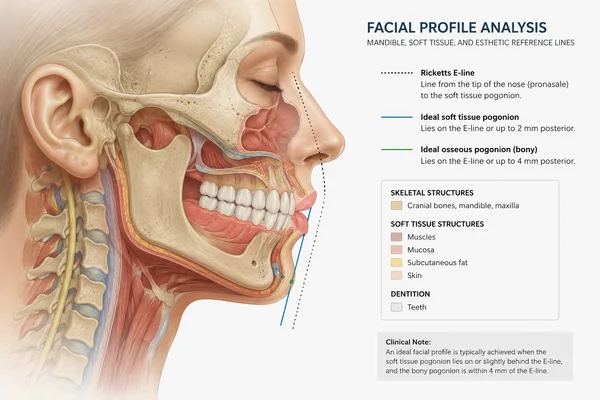
The chin’s aesthetic impact stems from its relationship to other facial landmarks. Aesthetic surgeons and injectors evaluate chin position using several key measurements: the Ricketts E-line (a line drawn from nose tip to chin that should lightly touch the lower lip), the Gonzalez-Ulloa line (vertical line from nasion to chin that should be perpendicular to Frankfurt horizontal plane), and the labiomental angle (the angle between lower lip and chin, ideally 120-130 degrees).
Your chin consists of the mentum (the bony prominence of the mandible) covered by soft tissue, muscle, and skin. With age, bone resorption can cause the chin to recede slightly—the mandible loses approximately 10-20% of its volume between ages 45-85, according to research published in Plastic and Reconstructive Surgery. This resorption, combined with soft tissue descent and fat pad deflation, can significantly alter lower face appearance.
Bakersfield’s outdoor lifestyle—with year-round sun exposure averaging 271 sunny days annually—accelerates collagen breakdown and bone density changes. UV radiation doesn’t just age skin; studies show chronic sun exposure correlates with increased rates of bone resorption in facial bones, making early intervention with volume restoration particularly relevant for Central Valley residents.
Seven Signs You’re a Candidate for Chin Filler
Chin augmentation with dermal filler works exceptionally well for specific aesthetic concerns. You may be an ideal candidate if you experience:
- Recessed chin profile: When viewing your face in profile, your chin sits noticeably behind your lower lip or nose, creating an imbalanced silhouette
- Weak chin-to-neck definition: Lack of forward chin projection makes it difficult to achieve a defined jawline, even with normal body weight
- Pre-jowl hollowing: Depressions on either side of the chin create shadows that age the lower face
- Asymmetric chin: One side of your chin projects less than the other, creating facial imbalance
- Flat or wide chin: Your chin lacks the subtle vertical dimension that creates an elegant, proportionate appearance
- Post-weight loss volume loss: Significant weight loss has reduced soft tissue volume in the chin area
- Desire to avoid surgery: You want improvement without surgical risks, permanent alterations, or extended recovery
Chin filler is particularly effective for mild to moderate concerns. Severe chin retrusion (recession beyond 8-10mm), significant skeletal asymmetry, or desire for dramatic projection may be better addressed with surgical implants or genioplasty (surgical chin advancement).
The Science Behind Chin Filler: How Hyaluronic Acid Creates Structure
Unlike softer fillers used in lips or under eyes, chin augmentation requires robust, high-G-prime (cohesive) hyaluronic acid products designed for deep structural support. Dr. Chang primarily uses FDA-approved fillers from the Juvéderm Voluma or Restylane Lyft families, both engineered for deep tissue placement and resistant to compression forces.
Hyaluronic acid works through multiple mechanisms. First, it provides immediate volumetric lift—the injected gel physically projects the chin forward. Second, HA attracts water molecules (each gram of HA can bind up to 1,000 times its weight in water), creating sustained hydration and subtle volume expansion over the first two weeks post-treatment. Third, emerging research suggests HA may stimulate modest collagen production through mechanical stretch of fibroblasts, though this secondary benefit remains under investigation.
The chin’s periosteal (bone surface) injection plane offers several advantages. Placing filler directly on bone provides a stable foundation that resists migration—unlike superficial placement in mobile soft tissue. The periosteal layer also has fewer blood vessels than mid-dermal planes, reducing bruising risk. Finally, bone-level placement creates a natural projection gradient, where the greatest volume sits at the pogonion (most forward chin point) and tapers smoothly into surrounding tissue.
Dr. Chang’s Precision Chin Augmentation Technique
As an oculoplastic surgeon trained in microsurgical techniques, Dr. Chang approaches chin filler with the same precision required for delicate eye surgery. His protocol includes:
Comprehensive facial analysis (15-20 minutes): Using digital photography from multiple angles and direct measurement, Dr. Chang evaluates your chin’s relationship to nose, lips, and jawline. He identifies asymmetries, bone structure, soft tissue thickness, and skin quality. This analysis determines ideal projection amount, optimal entry points, and whether additional treatments (like jawline filler or neck treatments) would enhance overall harmony.
Conservative volume planning: Most patients achieve optimal results with 1-3 syringes (1-3ml total) of high-density HA filler. Dr. Chang prefers staged treatment—addressing 70% of the desired change in the first session, then refining at a two-week follow-up. This approach prevents overcorrection and allows your facial proportions to “settle” before final adjustments.
Cannula-based injection: Rather than multiple needle punctures, Dr. Chang uses a single entry point with a blunt-tip microcannula. This flexible instrument glides through tissue planes without cutting blood vessels, dramatically reducing bruising and swelling. The cannula technique also allows continuous product deposition for smooth, even augmentation.
Supraperiosteal placement: Product is deposited directly on the bone surface in the supraperiosteal plane. This deep placement creates lasting structure and minimizes the risk of product migration or visible lumps. The periosteal layer provides a stable scaffold that maintains chin projection even during facial movement like talking or chewing.
Real-time assessment: Throughout the procedure, Dr. Chang evaluates your profile from multiple angles, using mirrors so you can provide feedback. He checks for symmetry, natural transitions, and proportional balance with your other features.
What to Expect: The Treatment Experience
Chin filler typically takes 30-45 minutes from consultation to completion. Here’s the step-by-step process:
Pre-treatment preparation (10 minutes): Your face is cleansed and photographed. A topical numbing cream is applied to the chin area and left for 10-15 minutes. Most patients find this sufficient for comfortable treatment, though dental nerve blocks can be added for those with heightened sensitivity.
The injection process (15-20 minutes): Dr. Chang makes a tiny entry point on each side of your chin using a micro-needle. The blunt cannula is then inserted and advanced along the bone surface while depositing filler in a fanning pattern. You’ll feel pressure and mild pulling sensations, but most patients report minimal discomfort. Modern HA fillers contain lidocaine, which provides additional numbing as treatment progresses.
Immediate refinement (5-10 minutes): Once the planned volume is placed, Dr. Chang gently molds the area to ensure even distribution and natural contours. He’ll have you sit upright and evaluate your profile in a mirror, making any micro-adjustments before you leave.
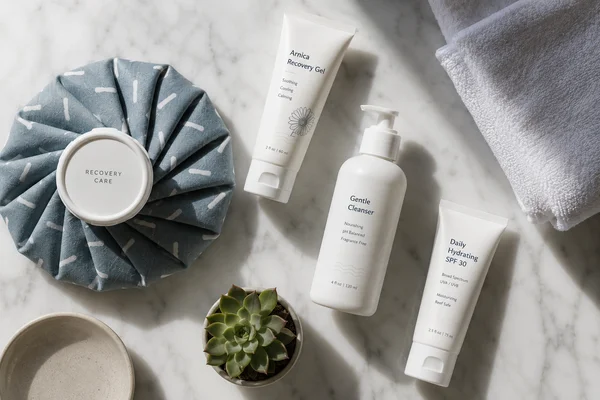
Post-treatment care: You can return to work immediately, though some patients prefer to take the rest of the day off if significant swelling occurs. Ice packs minimize swelling during the first 24-48 hours. Avoid strenuous exercise, alcohol, and blood-thinning supplements for 24 hours to reduce bruising risk.
Recovery Timeline and What to Expect
Days 1-3: Expect moderate swelling and possible bruising. The chin may feel firm to the touch. Most patients describe a “tight” sensation similar to mild sunburn. Swelling is typically most pronounced the morning after treatment and improves throughout the day as you remain upright.
Days 4-7: Swelling subsides significantly. Any bruising begins to fade. You can see approximately 60-70% of your final result. The chin still feels slightly firm when pressed.
Days 8-14: Minor residual swelling resolves. The filler integrates fully into surrounding tissue, and your chin feels natural to the touch. This is when Dr. Chang schedules your follow-up appointment to assess results and determine if refinement is needed.
Weeks 3-4: Final results are fully visible. The hyaluronic acid has attracted its full complement of water molecules, reaching its maximum volumetric effect. Your chin should look and feel completely natural, with no one suspecting you’ve had treatment.
Months 12-18: Results remain stable. Chin filler typically lasts 12-18 months due to the area’s limited muscle movement and deep placement on bone. Unlike lips (which move constantly) or cheeks (which compress when sleeping), the chin experiences minimal forces that break down filler.

Bakersfield’s dry climate (average humidity 20-30%) can impact recovery. Patients often experience slightly less swelling than in humid climates, but should maintain vigilant hydration and moisturizer use to support optimal healing.
Top 5 Results You Can Expect from Chin Filler
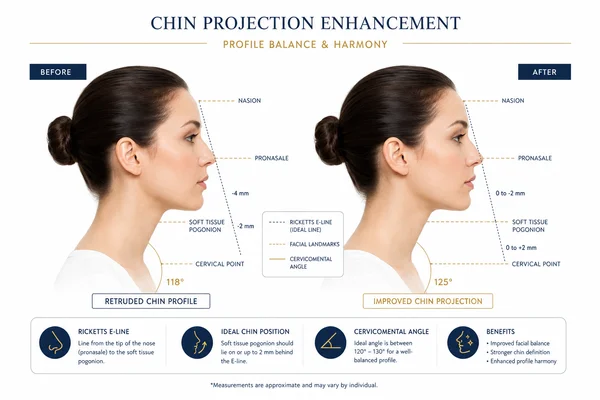
When performed by an experienced injector like Dr. Chang, chin augmentation with dermal filler delivers transformative yet natural improvements:
- Enhanced profile definition: Your chin projects forward to create better balance with your nose and forehead. The classic “weak chin” appearance is corrected, giving your profile more character and definition.
- Improved chin-to-neck angle: Forward chin projection creates a more acute cervicomental angle (the angle where your chin meets your neck). This enhanced definition makes your neck appear longer and more elegant, even without additional treatments.
- Balanced facial proportions: When your chin achieves ideal projection, your other features appear more harmonious. A nose that previously seemed large may look perfectly proportionate. Lips gain better definition against a properly projected lower face.
- Correction of asymmetry: Minor left-right differences in chin position or volume can be subtly corrected, creating better overall facial symmetry. This is particularly valuable for patients with developmental asymmetries or post-injury irregularities.
- Rejuvenated lower face: By restoring volume lost to age-related bone resorption, chin filler can take years off your appearance. The improved structure provides lift to surrounding tissues, often reducing the appearance of early jowling.
Results are immediate and continue to improve over the first two weeks as swelling resolves and the filler settles into its final position.
Choosing the Right Filler Product for Your Chin
Not all dermal fillers are appropriate for chin augmentation. The chin requires products with specific properties:
High G-prime (cohesivity): This measures the filler’s ability to maintain its shape under pressure. Chin fillers need G-prime values of 300+ Pascals to resist the compression forces of facial movement and tissue weight.
Low swelling factor: Products that absorb excessive water can create unpredictable volume changes. The best chin fillers have modest hygroscopic (water-attracting) properties for stable, predictable results.
Deep tissue approval: FDA approval specifies which tissue planes each product can be injected into. Chin fillers must be approved for deep (supraperiosteal or subcutaneous) placement.
Optimal products Dr. Chang uses:
- Juvéderm Voluma XC: The gold standard for chin augmentation. This product offers 24-month duration in cheeks and similar longevity in the chin. Its Vycross technology creates a dense HA matrix resistant to degradation.
- Restylane Lyft: Another excellent option with robust lift capacity. Slightly firmer consistency than Voluma, making it ideal for patients needing maximum structural support.
- Restylane Defyne: Used for more subtle chin refinement or in younger patients with good bone structure needing modest enhancement. Its flexible properties allow natural movement while providing support.
Dr. Chang selects your specific product based on your anatomy, aesthetic goals, skin thickness, and desired longevity. Some patients benefit from combining products—using firmer fillers for foundational structure and softer products for surface refinement.
Cost, Duration, and Financing in Bakersfield
Treatment cost: Chin filler typically requires 1-3 syringes depending on your starting anatomy and desired change. At Modern Aesthetic Institute, treatment ranges from $800-$2,400 total:
- 1 syringe (1ml): $800-$900 – suitable for subtle refinement
- 2 syringes (2ml): $1,500-$1,800 – most common for balanced enhancement
- 3 syringes (3ml): $2,200-$2,400 – for significant projection or male patients
Duration of results: Chin filler lasts 12-18 months on average. Factors affecting longevity include:
- Your metabolism (faster metabolisms break down HA more quickly)
- The specific product used (Voluma lasts longer than Defyne)
- Your activity level (extreme athletes may metabolize filler faster)
- Sun exposure (UV damage accelerates HA breakdown)
Financing options: Modern Aesthetic Institute partners with CareCredit and Cherry for flexible payment plans. Many patients choose 12-month interest-free financing, bringing the monthly cost to $125-$200 for comprehensive treatment.
Comparison to surgical alternatives: Surgical chin implants cost $4,500-$8,000 in Bakersfield and require general anesthesia, 1-2 weeks recovery, and permanent placement. While implants last indefinitely, they cannot be easily adjusted if facial aging changes your ideal proportions. Chin filler offers the flexibility to adapt your treatment as you age, with no surgical risks.
Bakersfield-Specific Considerations
Bakersfield’s unique environment influences both treatment planning and aftercare:
Sun protection is critical: With 271 sunny days and summer temperatures regularly exceeding 100°F, UV protection is non-negotiable. UV radiation degrades hyaluronic acid and accelerates filler breakdown. Apply SPF 30+ daily to your chin and lower face, and consider wearing a wide-brimmed hat during peak sun hours (10am-4pm).
Hydration matters more in dry climates: Bakersfield’s low humidity (averaging 23% annually) means your skin loses moisture rapidly. Well-hydrated skin supports longer filler duration. Drink 80-100 ounces of water daily and use a quality hyaluronic acid serum to maintain skin hydration.
Agricultural allergens affect healing: Central Valley’s agricultural production means higher pollen and dust exposure March through October. If you have seasonal allergies, consider scheduling chin filler during winter months (November-February) when allergen counts are lower and histamine responses won’t exacerbate swelling.
Scheduling around events: Many Bakersfield patients coordinate chin filler with the social calendar. The Kern County Fair (late September), holiday gatherings (November-December), and spring wedding season (April-May) are popular times to look your best. Schedule treatment 2-3 weeks before important events to allow complete healing.
Active outdoor lifestyle considerations: If you’re training for events like the Bakersfield Marathon or participate in outdoor sports, plan treatment during an off-week. Avoid vigorous exercise for 48 hours post-treatment to minimize swelling and bruising.
Frequently Asked Questions About Chin Filler
How many syringes of filler do I need for chin augmentation?
Most patients achieve balanced, natural results with 1-2 syringes (1-2ml total). Women typically need 1-2 syringes, while men often require 2-3 syringes due to larger facial structures and stronger jawlines that require proportionally more chin projection. Dr. Chang’s comprehensive facial analysis determines your specific needs based on your starting anatomy, desired projection amount, and facial proportions. Very subtle refinement may only require one syringe, while someone with significant chin retrusion might benefit from three syringes placed across multiple sessions.
Is chin filler painful?
Most patients describe chin filler as moderately comfortable. We apply topical numbing cream for 10-15 minutes before treatment, and modern fillers contain lidocaine that provides additional numbing during injection. The cannula technique Dr. Chang uses causes significantly less discomfort than traditional needle injection. You’ll feel pressure and a stretching sensation as the product is deposited, but sharp pain is rare. On a 1-10 pain scale, most patients rate the experience 2-4. For particularly sensitive individuals, we can add a dental nerve block for complete numbness.
Can chin filler look unnatural or “overdone”?
When performed conservatively by an experienced injector, chin filler creates subtle, natural-looking enhancement that harmonizes with your existing features. The risk of an unnatural result comes from overfilling (using too much product), poor product choice (using soft fillers that migrate), or improper placement (superficial injection that creates visible lumps). Dr. Chang’s approach emphasizes staged treatment—achieving 70% of your goal initially and refining at follow-up—which prevents the “overdone” appearance. Because chin filler is reversible with hyaluronidase, any concerns can be addressed immediately.
Will chin filler help with my double chin?
Chin filler primarily addresses forward projection and facial balance rather than submental (under-chin) fullness. However, improved chin projection can create the illusion of better chin-to-neck definition by sharpening the cervicomental angle. If you have true submental fat accumulation, combining chin filler with treatments specifically targeting that area—such as Kybella injections or CoolSculpting—delivers more comprehensive results. During your consultation, Dr. Chang evaluates whether your “double chin” appearance stems from chin recession (correctable with filler alone) or fat accumulation (requiring additional treatments).
How long does chin filler last?
Chin filler typically lasts 12-18 months, significantly longer than filler in more mobile areas like lips (6-9 months). The chin’s minimal muscle movement and deep periosteal placement contribute to extended duration. Individual factors affecting longevity include your metabolism, the specific product used, sun exposure, and lifestyle factors. Patients who maintain excellent sun protection, stay well-hydrated, and avoid excessive facial massage tend to enjoy results at the longer end of the range.
Why should I choose an oculoplastic surgeon for chin filler?
Dr. Chang’s training as a UCLA-trained oculoplastic surgeon provides unique advantages for facial filler treatment. Oculoplastic surgery requires microsurgical precision and deep understanding of facial anatomy, particularly the complex vascular networks and tissue planes. This training translates directly to superior filler technique—precise needle/cannula control, comprehensive anatomic knowledge for complication avoidance, and an aesthetic eye for facial harmony. While many providers offer chin filler, choosing an injector with surgical-level training ensures the highest safety and aesthetic standards.
Can chin filler migrate to other areas of my face?
When properly placed in the supraperiosteal plane (directly on bone), chin filler migration is extremely rare. The periosteal layer provides a stable foundation that holds product in place. Migration typically occurs when filler is placed too superficially in mobile soft tissue or when excessive amounts overwhelm the tissue’s capacity to integrate the product. Dr. Chang’s conservative volume approach and deep placement technique minimize migration risk to near zero. In the unlikely event of product movement, hyaluronidase can dissolve and reposition the filler.
What should I avoid after getting chin filler?
For the first 24-48 hours, avoid strenuous exercise, alcohol consumption, excessive heat (saunas, hot yoga), blood-thinning medications (aspirin, ibuprofen unless medically necessary), and direct pressure on the treated area (avoid sleeping face-down). For the first week, minimize extreme facial expressions or pressure on your chin. Long-term, maintain diligent sun protection and avoid aggressive facial treatments directly over the filler (such as deep microneedling or high-intensity laser) which can break down the product prematurely.
Schedule Your Chin Filler Consultation in Bakersfield
If you’re considering chin augmentation to enhance your profile and achieve better facial balance, Modern Aesthetic Institute offers the expertise and precision you deserve. Dr. Chang’s surgical training and conservative aesthetic approach ensure natural-looking results that enhance—never overpower—your unique features.
During your comprehensive consultation, Dr. Chang will evaluate your facial proportions, discuss your aesthetic goals, and create a customized treatment plan tailored to your anatomy and desired outcome. Whether you’re seeking subtle refinement or more significant enhancement, chin filler offers a safe, reversible path to the defined profile you’ve always wanted.
Contact Modern Aesthetic Institute today to schedule your consultation and discover how chin filler can transform your confidence without surgery or downtime.
Modern Aesthetic Institute
About the Author
Dr. Joseph H. Chang, MD is an ophthalmologist and fellowship-trained oculoplastic surgeon specializing in aesthetic and reconstructive procedures of the face and eyes. With advanced training in microsurgical techniques and facial anatomy, Dr. Chang brings surgical precision to every dermal filler treatment. His conservative, patient-centered approach prioritizes natural-looking results that enhance facial harmony while preserving each patient’s unique characteristics. Dr. Chang is committed to staying at the forefront of aesthetic medicine through continuing education and adoption of the latest evidence-based techniques.