
By Dr. Joseph H. Chang, MD | Ophthalmologist, Oculoplastic Surgery Specialist
That moment when you catch your reflection and wonder why you look exhausted—even after a full night’s sleep—is more common than you might think. Under-eye bags, dark circles, and hollowing can add years to your appearance, making you look tired or aged regardless of how rested you feel. If you’re exploring eyebag removal options in Bakersfield, you’re likely weighing two primary solutions: injectable fillers or blepharoplasty surgery. The truth is, both treatments have their place, but choosing the wrong one can lead to disappointing results or unnecessary procedures. As an oculoplastic surgeon with over 25 years of experience serving Bakersfield and Kern County, I’ve helped countless patients understand exactly which treatment will deliver the natural, refreshed results they’re seeking.
Understanding the Anatomy Behind Under-Eye Aging
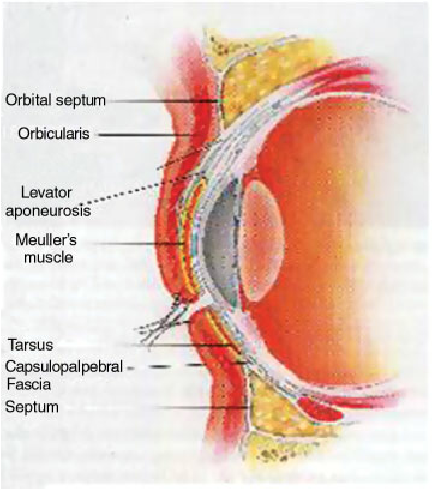
Before we explore treatment options, let’s understand what’s actually happening beneath the surface. The under-eye area is remarkably complex, consisting of thin skin (the thinnest on your entire body), delicate fat compartments, supporting ligaments, and underlying muscle. As we age, several changes occur simultaneously: fat pads that once sat neatly in place begin to bulge forward, creating those characteristic ‘bags.’ Meanwhile, volume loss in the cheeks and tear trough area creates hollowing and shadowing. The skin itself loses elasticity and begins to sag. Understanding your specific anatomy is the first step toward choosing the right treatment.
In my Bakersfield practice at Modern Aesthetic Institute, I see patients from Seven Oaks to Southwest Bakersfield who often self-diagnose their under-eye concerns without realizing that what appears to be ‘just dark circles’ might actually be a combination of hollowing, fat herniation, and skin laxity. This is where expertise becomes crucial—the solution isn’t one-size-fits-all, and the difference between exceptional results and disappointment often comes down to accurate diagnosis.
What Tear Trough Fillers Actually Do (And Don’t Do)
Tear trough fillers have revolutionized non-surgical under-eye rejuvenation, but they work best for very specific concerns. These injectable treatments, typically using hyaluronic acid-based products, are designed to restore lost volume in the tear trough—that groove that runs from the inner corner of your eye diagonally across the under-eye area. When you have hollowing that creates shadowing or dark circles, fillers can literally ‘fill’ that depression, smoothing the transition between your lower eyelid and cheek.
The results can be transformative for the right candidate. I’ve treated patients in Northwest Bakersfield and the Westchester area who looked years younger simply by restoring volume to this critical area. However—and this is important—fillers only add volume. They don’t remove excess skin, they don’t reposition bulging fat, and they won’t tighten loose tissue. In fact, placing filler in the wrong situation can actually make under-eye bags look worse, creating additional puffiness or that dreaded ‘overfilled’ appearance.
According to recent data from the American Society of Plastic Surgeons, tear trough filler procedures have increased by over 40% in the past five years, with patient satisfaction rates around 85% when performed correctly. The key phrase there? ‘When performed correctly.’ This treatment requires an expert understanding of facial anatomy—particularly in the delicate under-eye area where blood vessels, nerves, and thin skin demand precision.
The Science Behind Blepharoplasty: Surgical Precision for Lasting Results
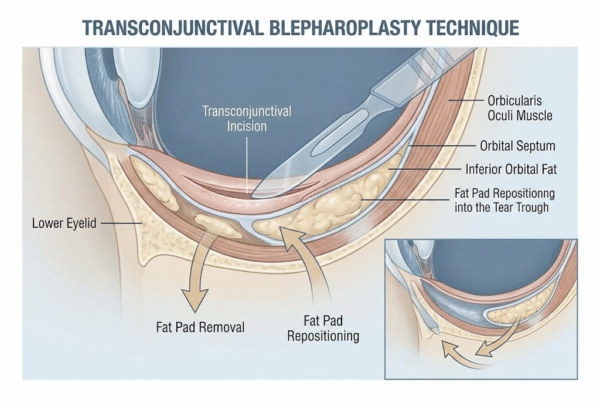
Lower eyelid blepharoplasty takes a fundamentally different approach. This surgical procedure addresses the structural changes that cause under-eye bags and sagging skin. During the procedure, I make a carefully placed incision—either just below the lash line or inside the eyelid (transconjunctival approach)—to access the underlying fat pads and tissue. Depending on your specific anatomy, the procedure might involve removing excess fat, repositioning fat to fill hollow areas, removing excess skin, or tightening the supporting structures.
The 2024 statistics from the International Society of Aesthetic Plastic Surgery reveal that eyelid surgery remains one of the most performed cosmetic procedures globally, with over 1.5 million procedures conducted annually. In the United States alone, blepharoplasty consistently ranks in the top five cosmetic procedures, with patients reporting high satisfaction rates that last for years.
What makes blepharoplasty particularly effective is its ability to address multiple concerns simultaneously. For my patients in Bakersfield and surrounding Kern County areas like Stockdale and Laurelglen, this means we can remove bulging fat, eliminate excess skin, and even address dark circles caused by shadowing—all in one procedure with results that typically last 7-10 years or longer.
7 Clear Signs You’re a Better Candidate for Fillers
How do you know if tear trough fillers are right for you? Here are seven clear indicators:
1. Visible Hollowing or Grooves
If you can see a defined depression running from the inner corner of your eye toward your cheek, and this creates a shadow that makes you look tired, fillers excel at smoothing this transition. The hallmark of a good filler candidate is volume loss, not excess tissue.
2. Minimal to No Excess Skin
Pull the skin under your eye gently. If it snaps back relatively quickly with little to no excess or crepiness, your skin quality is good enough for fillers. Loose, crepey skin needs surgical tightening, not volume addition.
3. Dark Circles from Shadowing, Not Pigmentation
True pigmentation issues (like melasma or hyperpigmentation) won’t improve with fillers. However, if your ‘dark circles’ are actually shadows created by hollowing or depressions, fillers can make a dramatic difference by eliminating the shadow-casting contour.
4. You’re Under 40 with Early Volume Loss
Younger patients experiencing premature hollowing due to genetics, weight loss, or natural facial structure often achieve excellent, natural-looking results with fillers. Your skin still has good elasticity, and you haven’t developed the structural changes that require surgery.
5. No Significant Puffiness or Bags
Here’s the critical distinction—if you don’t have noticeable under-eye bags or puffiness when you wake up, fillers might be your answer. The presence of bulging fat pads immediately disqualifies you as a filler-only candidate.
6. You Prefer Minimal Downtime
Filler treatments at my Bakersfield office typically take 30-45 minutes with virtually no downtime. Most patients return to work the same day, making this ideal for busy professionals in Kern County who can’t afford a week of recovery.
7. You Want to ‘Test Drive’ Facial Rejuvenation
Since hyaluronic acid fillers are reversible and temporary (lasting 9-18 months), they offer a low-commitment way to see how under-eye rejuvenation can transform your appearance. If you’re unsure about more permanent changes, fillers provide a reversible option.
These characteristics define the ideal filler candidate—someone dealing primarily with volume loss and hollowing, with good skin quality and no significant structural issues.
When Blepharoplasty Is Your Best Solution: The Definitive Indicators
Conversely, certain signs point clearly toward blepharoplasty as the more appropriate—and ultimately more satisfying—choice. If you have actual bags under your eyes (that puffy, bulging appearance caused by herniated fat pads), fillers simply can’t address this. In fact, adding filler when you already have excess tissue or puffiness often makes the problem worse, creating more volume in an area that already has too much.
Excess or loose skin is another clear indicator for surgery. As we age, the thin skin under our eyes loses collagen and elasticity, leading to wrinkling, crepiness, and sagging. No amount of filler can tighten loose skin—that requires surgical removal and, in some cases, laser resurfacing or skin tightening techniques performed in conjunction with blepharoplasty.
I’ve worked with many patients in the Seven Oaks and Olde Stockdale neighborhoods of Bakersfield who initially hoped fillers would solve their under-eye concerns, only to realize after consultation that their anatomy requires a surgical solution. The good news? Lower blepharoplasty, when performed by an experienced oculoplastic surgeon, delivers natural-looking results that last for years, often eliminating the need for repeated treatments.
Lower eyelid laxity—where the eyelid has lost its tight attachment to the eye—also requires surgical correction. This condition can cause the lower lid to pull away from the eyeball (called ectropion) or turn inward (entropion), creating both cosmetic and functional problems. Structural issues like these fall well beyond the capabilities of injectable treatments.
Finally, if you’ve had filler treatments in the past with unsatisfactory results, persistent puffiness, or that ‘overfilled’ look, blepharoplasty might be necessary to correct the issue and provide the natural contour you’ve been seeking.
The ‘Combination Approach’: When Both Treatments Work Together
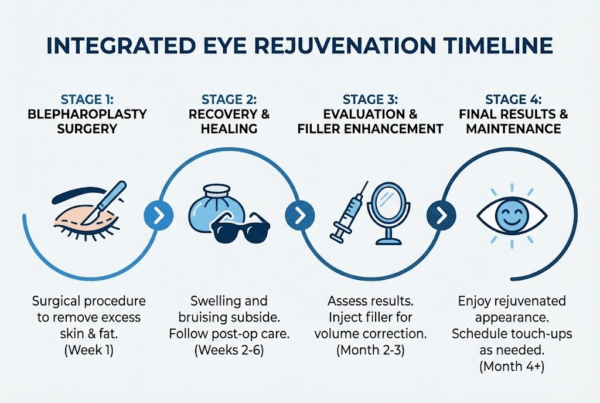
Here’s something many patients don’t realize: these treatments aren’t always mutually exclusive. In my practice, I often recommend a combination approach where blepharoplasty addresses the structural issues—removing excess fat and tightening skin—while strategic filler placement adds volume exactly where it’s needed for optimal contour and smoothness.
Think of it this way: surgery creates the foundation by correcting the structural problems, while fillers provide the finishing touches by fine-tuning volume and contour. For example, after performing lower blepharoplasty to remove under-eye bags and excess skin, I might use a small amount of filler in the tear trough area several months later to achieve the smoothest possible transition between the lower eyelid and cheek.
This combined approach is particularly effective for patients in their 50s and 60s who have both fat herniation (requiring removal) and volume loss in surrounding areas (requiring restoration). According to research published in the National Center for Biotechnology Information, patients who underwent combined procedures reported satisfaction rates exceeding 90%, compared to 75-80% for single-treatment approaches.
The timing matters, too. Generally, I recommend completing any surgical procedures first, allowing complete healing (typically 3-6 months), and then assessing whether strategic filler placement would enhance the results. This staged approach prevents over-correction and ensures the most natural outcome.
What to Expect: Recovery, Results, and Realistic Timelines
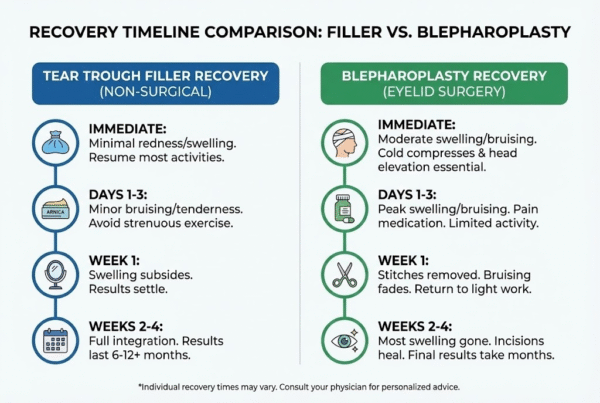
Let’s talk honestly about what each treatment involves. With tear trough fillers at Modern Aesthetic Institute in Bakersfield, the appointment typically lasts 30-45 minutes. I use a topical anesthetic to minimize discomfort, though most patients describe the sensation as brief pressure rather than pain. You might experience minor swelling or bruising for 2-3 days, but most patients return to work immediately. Results are visible right away, though final results emerge after any minor swelling subsides within a week. The effects last anywhere from 9-18 months depending on the product used, your metabolism, and the amount injected.
Blepharoplasty involves more significant recovery but delivers longer-lasting results. The procedure itself takes 1-2 hours depending on whether we’re treating upper lids, lower lids, or both. I perform most procedures under local anesthesia with sedation, though some patients prefer general anesthesia. You’ll have some swelling and bruising for 7-10 days, and I typically recommend patients take a week off work—though many of my patients in Northwest Bakersfield return to desk work within 4-5 days wearing sunglasses.
Stitches (if external incisions are used) are removed after about a week. Most of the visible swelling resolves within two weeks, though subtle refinement continues for 3-6 months as tissues fully settle. The results? They typically last 7-15 years, and many patients never need a second procedure. Johns Hopkins Medicine reports that over 90% of blepharoplasty patients are satisfied with their results five years post-procedure.
For patients considering either treatment in Bakersfield or anywhere in Kern County, I always emphasize the importance of realistic expectations. Neither treatment will completely erase all signs of aging or create a face that doesn’t look like ‘you.’ The goal is refreshed, natural-looking rejuvenation that makes you look like yourself on your best day—well-rested, approachable, and years younger.
Cost Considerations: Investment vs. Value Over Time
The financial aspect deserves honest discussion. Under-eye filler is priced per treatment session, depending on how much product is needed. Since results last 9-18 months, you’re looking at ongoing maintenance costs every year to year-and-a-half. Over a decade, those repeat sessions add up.
Lower blepharoplasty, by contrast, typically costs $4,000 to $8,000 including surgeon, facility, and anesthesia fees, but results last significantly longer—often 10-15 years or more. When you calculate the long-term value, surgery often proves more cost-effective for patients with structural concerns that truly require surgical correction.
That said, cost shouldn’t be the only factor in your decision. The right treatment is the one that addresses your specific anatomy and concerns. I’ve seen patients waste thousands on repeated filler treatments when they really needed surgery, just as I’ve seen others undergo unnecessary surgery when fillers would have provided excellent results with no downtime.
Many practices, including Modern Aesthetic Institute, offer financing options through companies like CareCredit that make either treatment more accessible with monthly payment plans. The key is choosing the treatment that’s right for your anatomy first, then exploring the financial options that work for your budget.
Choosing Your Provider: Why Expertise Matters More Than Ever
Here’s an uncomfortable truth: the under-eye area is one of the most challenging regions to treat, whether with fillers or surgery. The proximity to the eye, the thin skin, the complex vascular anatomy, and the unforgiving nature of the area (every imperfection shows) mean that expertise absolutely matters.
For filler treatments, you want a provider who understands not just injection technique but facial anatomy, aging patterns, and when not to inject. The under-eye area has unique risks including vascular occlusion (blocking blood vessels), Tyndall effect (bluish discoloration from superficial filler), and migration. These complications require immediate recognition and treatment—something only experienced injectors can provide.
For blepharoplasty, choosing an oculoplastic surgeon—a specialized physician trained in both ophthalmology and plastic surgery of the eye area—provides an added layer of safety and precision. We understand not just the aesthetics but the functional aspects of the eyelids and their relationship to eye health. My training at UCLA’s Jules Stein Eye Institute, combined with over 25 years of experience specifically in eyelid surgery, means I approach each procedure with both surgical skill and an intimate understanding of the delicate structures we’re working with.
Bakersfield patients have options when it comes to cosmetic treatments, but the under-eye area isn’t the place to choose your provider based solely on price or convenience. Research credentials, review before-and-after photos, and ensure your provider has extensive specific experience with the exact treatment you’re considering.
Making Your Decision: A Personalized Approach for Bakersfield Patients
The choice between fillers and blepharoplasty isn’t about which treatment is ‘better’—it’s about which treatment is right for your unique anatomy, concerns, and goals. I’ve seen remarkable transformations with both approaches when properly matched to the patient’s needs.
During consultations at Modern Aesthetic Institute, I take time to carefully examine your under-eye anatomy, discuss your concerns and expectations, and provide honest guidance about which approach will deliver the results you’re seeking. Sometimes that means recommending the less expensive, non-surgical option. Other times, it means having a candid conversation about why surgery is the only solution that will truly address your concerns.
For Kern County residents from Seven Oaks to Southwest Bakersfield, having access to both advanced injectable techniques and specialized oculoplastic surgery means you don’t have to compromise. You can trust that the recommendation you receive is based on what’s truly best for your anatomy—not on what’s easiest or most profitable for the practice.
Take the Next Step Toward Refreshed, Youthful Eyes
If you’re tired of looking tired and ready to explore your options for under-eye rejuvenation in Bakersfield, I invite you to schedule a consultation at Modern Aesthetic Institute. During your visit, we’ll carefully assess your anatomy, discuss your goals, and create a personalized treatment plan—whether that involves fillers, surgery, or a combination approach tailored specifically to you.
Ready to take the next step toward refreshed, natural-looking eyes? Contact Modern Aesthetic Institute at (661) 535-0149 or visit us at 4000 Empire Drive, Suite 300, Bakersfield, CA 93309. We serve patients throughout Kern County including Seven Oaks, Northwest Bakersfield, Stockdale, and surrounding communities.
Still have questions about eyebag removal options? Explore our website at modernaesthetic.institute to learn more about our approach to aesthetic treatments, view our before-and-after gallery, and discover why Bakersfield residents trust Dr. Chang for expert eyelid rejuvenation.
About Dr. Joseph H. Chang
Dr. Joseph H. Chang is an ophthalmologist specializing in oculoplastic surgery with over 25 years of experience serving the Bakersfield and Kern County communities. Trained at UCLA’s prestigious Jules Stein Eye Institute, Dr. Chang has performed thousands of eyelid procedures and has 25+ years of injectable experience. At Modern Aesthetic Institute, Dr. Chang combines surgical precision with artistic sensibility to deliver natural-looking results that enhance your inherent beauty. His philosophy centers on personalized care, honest guidance, and treatments that make you look like yourself—just more refreshed and confident.
Frequently Asked Questions
How do I know if I need fillers or blepharoplasty for under-eye bags in Bakersfield?
The determination comes down to your specific anatomy. If you have hollowing or depressions under your eyes without significant puffiness or excess skin, tear trough fillers are likely ideal. However, if you have actual bags (bulging fat), loose or crepey skin, or lower eyelid laxity, blepharoplasty provides the comprehensive correction you need. A consultation with an experienced oculoplastic surgeon like Dr. Chang in Bakersfield will provide a definitive answer based on your individual concerns.
Are under-eye fillers safe, and what are the potential complications?
When performed by an experienced injector, tear trough fillers are generally safe with high satisfaction rates. However, the under-eye area does carry unique risks including bruising, swelling, asymmetry, Tyndall effect (bluish discoloration), and rarely, vascular occlusion. Choosing a provider with extensive anatomical knowledge and specific experience with tear trough injections—like Dr. Chang at Modern Aesthetic Institute in Bakersfield—significantly minimizes these risks.
How long does recovery take after lower eyelid blepharoplasty in Bakersfield?
Most patients experience 7-10 days of visible swelling and bruising, with many returning to work within a week. Stitches are typically removed after 5-7 days, and most social activities can resume within two weeks. Complete healing and final results emerge over 3-6 months, though you’ll see significant improvement within the first month. Dr. Chang provides detailed post-operative instructions to ensure smooth recovery for all Kern County patients.
Can under-eye fillers make bags worse?
Yes, if fillers are placed incorrectly or when surgery is actually needed, they can create additional puffiness and worsen the appearance of under-eye bags. This is why proper diagnosis is crucial. If you already have bulging fat or significant puffiness, adding volume through fillers often exacerbates the problem. An experienced provider will recognize when fillers aren’t appropriate and recommend alternative treatments.
What’s the difference between a plastic surgeon and an oculoplastic surgeon for eyelid surgery?
Oculoplastic surgeons complete specialized fellowship training beyond plastic surgery, focusing specifically on the eye area, eyelids, tear ducts, and orbit. This additional training provides expertise in both the aesthetic and functional aspects of the eyes. Dr. Chang’s background as an ophthalmologist with oculoplastic specialization means he brings both surgical precision and comprehensive understanding of eye health to every procedure at Modern Aesthetic Institute.
How long do tear trough filler results last in Bakersfield’s climate?
Results typically last 9-18 months depending on the product used, your individual metabolism, and lifestyle factors. Bakersfield’s warm climate doesn’t significantly impact longevity, though sun exposure can accelerate facial aging overall. Dr. Chang uses premium hyaluronic acid fillers that provide consistent, natural-looking results throughout their duration. Many Kern County patients schedule maintenance treatments annually or every 12-15 months.
What age should I consider eyebag removal treatments?
There’s no specific ‘right age’—it depends on your individual anatomy and concerns. Some patients in their 30s develop hereditary under-eye bags or hollowing that benefit from early treatment, while others don’t need intervention until their 50s or 60s. The key is addressing concerns when they bother you, rather than waiting for a specific age. Younger patients often achieve excellent results with fillers, while more advanced aging typically requires surgical correction.
Does insurance cover blepharoplasty for under-eye bags in California?
Modern Aesthetic Institute is a self-pay practice. We do not bill insurance or prepare insurance paperwork. Instead, you receive clear, transparent pricing at your consultation, and your treatment plan is decided by you and your surgeon rather than a carrier. Most insurers classify cosmetic eyelid surgery as elective, so self-pay keeps the process simple and predictable.