
By Dr. Joseph H. Chang, MD
Ophthalmologist | Oculoplastic Specialist
Few concerns cause more anxiety among filler patients than the possibility of migration, the phenomenon where dermal filler moves from its intended placement location to surrounding tissue, creating unintended fullness, distortion, or the dreaded “pillow face” appearance. Social media has amplified these fears with dramatic before-and-after images, celebrity examples, and viral warnings about filler “traveling” across the face.
Yet the reality of filler migration is more nuanced than sensational headlines suggest. True migration occurs less frequently than commonly believed when filler is placed by experienced injectors using proper technique, appropriate products, and conservative volume. Understanding what actually causes filler to move, and distinguishing genuine migration from other phenomena like swelling, improper initial placement, or overfilling, empowers you to make informed decisions about your aesthetic treatments.
In Bakersfield’s growing aesthetic medicine landscape, where injectable treatments have become increasingly accessible through medical spas, general practitioners, and cosmetic nurses, the risk of poor technique increases proportionally. At Modern Aesthetic Institute, Dr. Joseph H. Chang’s training in ophthalmology, fellowship training in oculoplastic surgery at UCLA’s Jules Stein Eye Institute, and recognition as a Dr. Chang (by volume since 2016) provide the anatomical expertise and technical precision that prevent migration before it occurs.
This comprehensive guide explains the science behind filler migration, why it happens, which facial areas are most vulnerable, how to recognize the problem early, and what correction options exist if you’re experiencing unwanted filler movement. After 25+ years serving Bakersfield and Kern County, Dr. Chang brings both the knowledge to prevent migration and the expertise to correct it when it occurs.
What Is Filler Migration? Defining the Problem Accurately
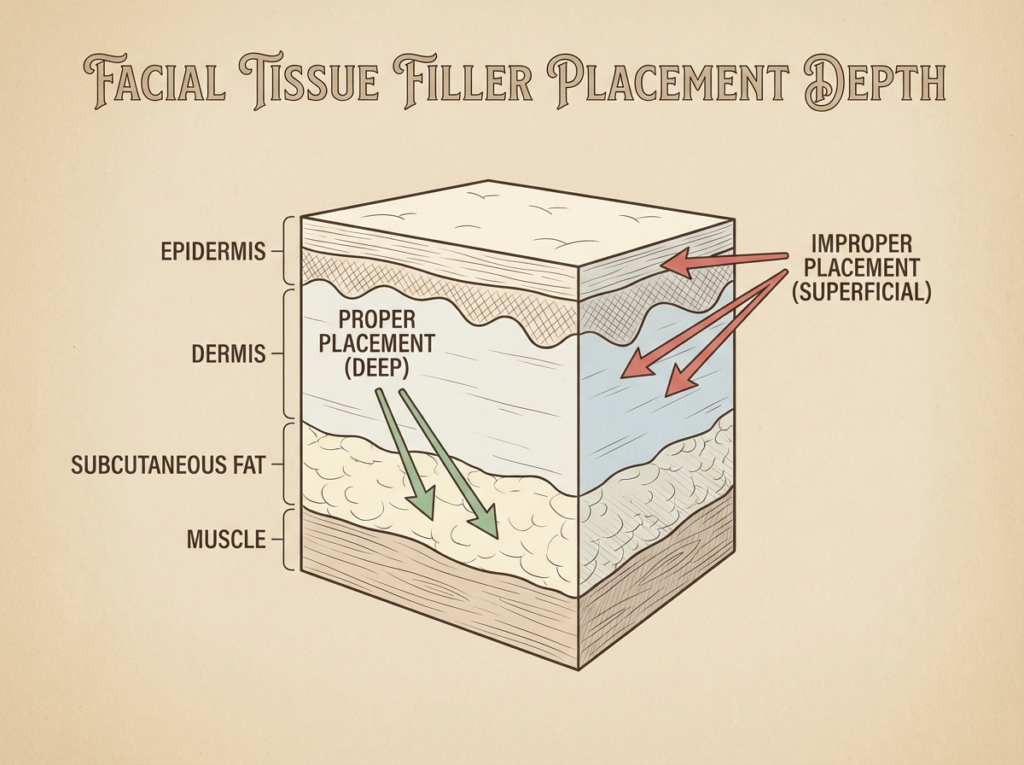
Filler migration refers to hyaluronic acid (or other filler materials) moving from the original injection site to adjacent tissue areas, creating fullness where no product was intentionally placed. This differs fundamentally from:
Swelling (Not Migration)
Immediate post-injection swelling represents normal inflammatory response and fluid retention, not filler movement. This swelling typically peaks at 24-48 hours and resolves within 5-7 days. Patients often mistake this temporary puffiness for migration.
Improper Initial Placement (Not Migration)
Sometimes filler is simply injected in the wrong location from the start. This isn’t migration, it’s incorrect technique. The product never moves; it was placed poorly to begin with.
Overfilling (Not Migration)
Excessive filler volume in the correct location creates a puffy, unnatural appearance that patients may describe as “migration” when it’s actually just too much product.
True Migration
Genuine filler migration occurs when properly placed product gradually shifts from the intended tissue plane or location to adjacent areas over weeks or months. This happens through several mechanisms:
Hydrophilic Expansion: Hyaluronic acid attracts water (up to 1000 times its weight). In certain tissue environments, this water attraction can cause filler to swell and exert pressure that pushes it into adjacent spaces.
Tissue Plane Disruption: Filler placed in incorrect tissue depths (too superficial) or in highly mobile areas experiences constant mechanical forces that encourage movement.
Gravity and Facial Movement: Certain facial areas, particularly around the mouth and eyes, experience thousands of repetitive movements daily (talking, chewing, blinking) that can gradually displace filler over time.
Lymphatic Flow: The body’s lymphatic system slowly metabolizes hyaluronic acid. In areas with robust lymphatic drainage, filler can be “carried” in the direction of lymph flow before fully integrating into tissue.
Understanding these distinctions helps you recognize whether your concern represents true migration requiring intervention or temporary normal post-treatment effects that will resolve spontaneously. Dermatologic Surgery Journal
High-Risk Areas: Where Migration Occurs Most Frequently

Not all facial areas are equally vulnerable to filler migration. Certain zones present higher risk due to anatomical characteristics:
1. Lips (Highest Risk Area)
The lips experience constant movement, talking, eating, drinking, facial expressions, creating mechanical forces that can shift filler. Additionally:
- Thin, mobile tissue provides less structural support
- Rich vascular supply and lymphatic drainage metabolize filler more actively
- Patients often receive touch-ups that layer additional product over partially metabolized previous filler
Common Migration Pattern: Filler migrating from the lip body into the vermillion border (creating “duck lips”), or extending above the lip line into the pink tissue.
2. Tear Troughs (Under-Eye Area)
The delicate under-eye tissue is only 0.5mm thick with minimal subcutaneous support. Migration risks include:
- Filler placed too superficially moving laterally toward the mid-face
- Product shifting with eye movement and facial expressions
- Inadequate tissue support allowing gravity-driven descent
Common Migration Pattern: Filler extending beyond the orbital rim onto the cheek, creating unintended mid-face fullness.
3. Nasolabial Folds
The area around your smile lines experiences significant movement with facial expressions. When filler is placed:
- Too superficially (in the dermis rather than deeper planes)
- In excessive volume
- Using low-cohesivity products
It can migrate laterally onto the cheek or upward toward the nose.
4. Around the Mouth (Perioral Region)
The muscles surrounding your mouth (orbicularis oris) contract constantly. Filler placed here can:
- Migrate vertically along muscle fibers
- Shift with repetitive chewing motions
- Move due to speech articulation patterns
Common Migration Pattern: Filler intended for lip lines or marionette lines extending into the chin or jawline area.
5. Lower Face and Jawline
While generally more stable due to placement on bone, jawline filler can migrate if:
- Placed too superficially (in fat or muscle rather than supraperiosteal)
- Used in excessive volume creating pressure
- Applied to patients with significant remaining facial fat or tissue laxity
The Science of Why Filler Migrates: Understanding Causation
Multiple factors contribute to filler migration risk, often working in combination:
Incorrect Product Selection
Not all hyaluronic acid fillers have the same physical properties. Products vary in:
Cohesivity: The ability to maintain shape and resist spreading. Low-cohesivity fillers designed for delicate areas (lips, tear troughs) will migrate if used in high-movement zones.
Viscosity: Thickness and resistance to flow. Thin fillers placed in mobile areas can’t withstand mechanical forces and will gradually shift.
Cross-linking Density: How tightly the HA molecules are bonded together. Lower cross-linking means faster breakdown and more susceptibility to movement.
Example: Using a soft lip filler for jawline augmentation invites migration because the product lacks structural integrity for that location.
Improper Injection Depth
Facial tissue consists of multiple layers (skin, dermis, subcutaneous fat, muscle, bone). Filler must be placed in the appropriate depth for the treatment area:
Too Superficial: Product in the dermis or just beneath it is visible, palpable, and highly susceptible to migration due to constant skin movement.
Correct Depth: Depends on the facial zone, tear troughs require supraperiosteal (on bone) placement; cheeks may use deep subcutaneous or submuscular planes; lips tolerate submucosal placement.
Dr. Chang’s oculoplastic training provides intimate knowledge of facial tissue planes that general injectors may lack, enabling precise depth selection that prevents migration.
Excessive Volume (Overfilling)
Perhaps the most common migration risk factor, overfilling creates several problems:
- Tissue Pressure: Too much filler generates internal pressure that forces product into adjacent spaces
- Loss of Natural Anatomy: Overwhelming natural tissue structure with excessive volume distorts normal anatomical boundaries
- Accumulation Over Time: Patients receiving frequent touch-ups may accumulate more filler than they realize, as previous product hasn’t fully metabolized
The Instagram-driven aesthetic emphasizing dramatic fullness has unfortunately encouraged overfilling trends that increase migration risk significantly.
High Facial Mobility
Certain patients have naturally more expressive faces with exaggerated facial movements. This heightened mobility:
- Creates stronger mechanical forces on placed filler
- Occurs thousands of times daily (talking, chewing, smiling)
- Gradually shifts even properly placed product over months
These patients may be better candidates for more conservative filler volume or alternative treatments entirely.
Inadequate Integration Time
Hyaluronic acid filler requires approximately 2-4 weeks to fully integrate into surrounding tissue. During this period, the filler is more vulnerable to movement. Patients who:
- Undergo aggressive facial massage too soon
- Receive dental work immediately after lip filler
- Engage in high-impact exercise within 48 hours
- Apply significant pressure to treated areas
May disrupt filler before it stabilizes, encouraging migration.
7 Signs Your Filler May Have Migrated

Recognizing migration early allows for prompt correction before problems worsen. Watch for these indicators:
1. Fullness in Untreated Areas
You notice puffiness or volume in locations where you never received filler, for example, cheek fullness after only tear trough treatment, or upper lip fullness above the vermillion border when filler was placed only in the body of the lip.
2. Asymmetric Appearance
One side of your face appears fuller or more distorted than the other, despite symmetric initial treatment. Migration often occurs unevenly due to individual facial anatomy and movement patterns.
3. Progressive Change Over Time
Your filler looked natural initially but has gradually created a puffy, unnatural appearance over weeks or months. True migration is typically a gradual process rather than sudden change.
4. Visible Lumps or Ridges
You can see or feel distinct areas of product accumulation that weren’t present immediately after treatment. This suggests filler has collected in certain locations rather than remaining evenly distributed.
5. “Shelf” Appearance
Particularly common with lip filler, a visible line or shelf where filler has migrated above the natural lip border, creating an obvious demarcation between lip and skin.
6. Worsening with Repeated Touch-Ups
Each subsequent filler treatment makes the problem more pronounced rather than simply maintaining your desired look. This suggests accumulating product that hasn’t fully metabolized.
7. Unnatural Facial Proportions
Your face appears wider, heavier, or distorted compared to your pre-filler appearance and your natural bone structure. This often results from migration combined with overfilling.
If you’re experiencing any of these signs, schedule an evaluation with an expert injector like Dr. Chang who can assess whether you’re dealing with migration, overfilling, or another issue requiring correction.
Prevention Strategies: Dr. Chang’s Approach to Reducing Migration Risk

The best migration treatment is prevention. Dr. Chang’s methodology minimizes risk through multiple safeguards:
Conservative Volume Philosophy
Rather than attempting dramatic transformation in a single session, Dr. Chang recommends:
- Initial Conservative Treatment: Using minimal effective volume to achieve subtle improvement
- Assessment Period: Waiting 2-4 weeks for full integration and swelling resolution
- Strategic Layering: Adding additional volume gradually over multiple sessions if desired, rather than frontloading excessive product
This staged approach prevents the tissue pressure and overcorrection that drive migration.
Appropriate Product Selection for Each Facial Area
Dr. Chang matches filler characteristics to treatment location:
Tear Troughs: Low-viscosity, highly cohesive HA fillers designed specifically for delicate under-eye tissue (Restylane-L, Belotero Balance)
Lips: Medium-viscosity products formulated for dynamic areas with appropriate flexibility (Restylane Kysse, Juvéderm Ultra XC)
Cheeks & Mid-Face: Robust, cohesive fillers providing structural support (Juvéderm Voluma, Restylane Lyft)
Jawline: High-viscosity, highly cohesive products resisting movement (Juvéderm Volux, Radiesse)
Using the wrong product in a given area, regardless of injector skill, increases migration risk substantially.
Precise Depth and Plane Selection
Dr. Chang’s oculoplastic training ensures filler placement in optimal tissue planes:
- Tear Troughs: Supraperiosteal (directly on orbital bone) to prevent superficial visibility and lateral migration
- Cheeks: Deep subcutaneous or submuscular for structural support without surface irregularity
- Lips: Submucosal placement that integrates with lip tissue rather than sitting superficially
- Jawline: Supraperiosteal along mandibular border for maximum stability
Proper depth selection, guided by surgical anatomical knowledge, is perhaps the single most important migration prevention factor.
Recognizing High-Risk Patients
Not everyone is an ideal filler candidate. Dr. Chang identifies patients at elevated migration risk:
- Very thin facial skin with minimal subcutaneous tissue
- Extremely expressive faces with exaggerated movement patterns
- History of previous filler migration with other providers
- Unrealistic expectations requiring excessive volume for satisfaction
- Anatomical factors (severe tissue laxity, significant facial asymmetry)
For these patients, Dr. Chang may recommend alternative treatments, more conservative protocols, or honest guidance that injectable filler may not achieve desired results safely.
Patient Education and Aftercare
Preventing migration continues after you leave the treatment room:
- Avoid Pressure: No aggressive facial massage, sleeping face-down, or applying significant pressure to treated areas for 2 weeks
- Minimize Movement: Temporarily reducing excessive facial expressions in treated zones during the first week helps filler integrate
- No Dental Work: Delaying intensive dental procedures for 2 weeks after lip or lower face filler
- Gradual Exercise: Avoiding high-impact cardiovascular activity for 48 hours post-treatment
Proper aftercare significantly reduces migration risk during the vulnerable integration period.
Correcting Filler Migration: Treatment Options
If migration has occurred, several correction approaches exist:
1. Hyaluronidase Dissolution (Most Common Solution)
For hyaluronic acid fillers, hyaluronidase enzyme dissolves the product within 24-48 hours. This treatment:
How It Works: Hyaluronidase breaks down HA molecules, allowing your body to metabolize and eliminate them rapidly through natural processes.
Treatment Process:
- Dr. Chang precisely injects hyaluronidase into areas of migrated filler
- Results become visible within hours, with full dissolution by 24-48 hours
- Multiple treatment sessions may be necessary for extensive migration
- After complete dissolution, waiting 2-4 weeks before re-treating allows tissue to return to baseline
Advantages:
- Quick, effective correction of HA filler problems
- Minimal discomfort (similar to original filler injection)
- Allows complete “reset” for proper re-treatment
Considerations:
- Only works for hyaluronic acid fillers (not Radiesse, Sculptra, or permanent fillers)
- May dissolve naturally occurring hyaluronic acid in treated area temporarily
- Requires experienced injector to target migrated product without affecting properly placed filler
2. Targeted Partial Dissolution
Rather than removing all filler, Dr. Chang can strategically dissolve only the migrated portion:
- Identifying specific areas where product has accumulated
- Using minimal hyaluronidase to reduce (not eliminate) the migrated filler
- Preserving filler in correctly placed locations
- Achieving more balanced appearance without complete removal
This approach works best for minor migration where most of your filler remains appropriately placed.
3. Time and Natural Metabolism
Hyaluronic acid filler gradually breaks down naturally over 6-18 months depending on product type, location, and individual metabolism. For mild migration causing only cosmetic concern (no functional problems), simply allowing natural dissolution is a valid option:
Advantages:
- No additional procedures or costs
- No risk of over-correction
- Natural gradual improvement
Disadvantages:
- Requires patience (months rather than days)
- Migration may worsen slightly before improving
- Doesn’t address immediately if problem is severe
4. Strategic Additional Filler for Balancing
In select cases, adding filler to other facial areas can create better overall proportion and diminish the appearance of migration:
- Example: If tear trough filler has migrated laterally onto the cheek, adding volume to the medial cheek bone can create more balanced mid-face appearance
- This approach doesn’t remove migrated product but reduces its visual impact through improved facial harmony
This technique requires significant expertise and should only be attempted by experienced injectors who understand three-dimensional facial aesthetics.
Migration vs. Other Filler Complications: Accurate Diagnosis Matters
Patients often attribute various filler concerns to “migration” when the actual problem differs:
Prolonged Swelling (Inflammatory Response)
Some patients experience swelling lasting weeks or even months due to:
- Low-grade inflammatory reaction to the filler itself
- Bacterial biofilm formation (rare but possible)
- Allergic or sensitivity reaction
Key Difference: Swelling affects the entire treated area uniformly, while migration creates focal fullness in untreated adjacent zones.
Tyndall Effect (Under-Eye Blue Discoloration)
Superficially placed tear trough filler can create blue-gray discoloration from light scattering (Tyndall effect). Patients may call this “migration” but it’s actually:
- Filler placed too superficially from the start (improper initial technique)
- Product choice inappropriate for the area
Correction: Hyaluronidase dissolution followed by proper deep placement re-treatment.
Natural Facial Changes (Aging, Weight Gain)
Sometimes “migration” is actually continued aging, volume loss, or weight fluctuation creating new facial proportions:
- Filler remains exactly where placed
- Your face has changed around it
- What looked natural initially now appears disproportionate
Solution: Comprehensive facial rejuvenation addressing new concerns rather than assuming existing filler migrated.
Dr. Chang’s thorough evaluation distinguishes between true migration and these alternative explanations, ensuring appropriate treatment rather than unnecessary dissolution.
Bakersfield-Specific Considerations
Central Valley environmental factors affect filler stability and migration risk:
Heat and Sun Exposure
Bakersfield’s extreme summer temperatures (often 100-110°F) and intense UV exposure can:
- Increase inflammation that potentially affects filler placement
- Cause temporary swelling that patients mistake for migration
- Accelerate filler metabolism, requiring more frequent touch-ups that risk overfilling
Management:
- Schedule filler treatments during cooler months when possible
- Aggressive sun protection (SPF 50+, reapplication every 2 hours)
- Avoid extended sun exposure for 48-72 hours post-treatment
- Stay well-hydrated to minimize inflammation
Outdoor Lifestyle and Physical Activity
Active outdoor lifestyles common in agricultural Kern County mean:
- More facial sun damage affecting tissue quality and filler integration
- Higher impact physical activity that should be temporarily avoided post-treatment
- Greater environmental exposure requiring protective measures
Provider Training and Treatment Planning
Filler migration risk can be influenced by product choice, placement depth, treatment volume, anatomy, and aftercare. Ask any injector about medical training, experience with the treatment area, product sourcing, and how complications are evaluated and managed.
Questions to Ask Your Injector About Migration Prevention

Protect yourself by asking potential providers:
- “What specific strategies do you use to prevent filler migration?” (Should discuss product selection, depth, volume philosophy)
- “Have you ever had a patient experience filler migration? How did you handle it?” (Honest injectors acknowledge complications happen; their management approach reveals competence)
- “Which filler product will you use for my specific treatment area, and why?” (Should demonstrate knowledge of product characteristics matched to facial zones)
- “How much filler (in syringes/mL) do you typically use for this treatment?” (Compare to norms; excessive volume suggestions are red flags)
- “Do you have hyaluronidase immediately available if complications occur?” (Should be on-site for every filler appointment)
- “Can you show me before-and-after photos of patients you’ve treated who had similar anatomy to mine?” (Evidence of natural, conservative results)
- “What’s your training background in facial anatomy?” (Surgical training, medical degree, certification all matter significantly)
An experienced injector welcomes these questions and answers confidently without defensiveness.
When to Seek Immediate Evaluation
Most filler concerns develop gradually, but certain symptoms require urgent assessment:
- Sudden severe pain in the treated area (possible vascular occlusion)
- Skin color changes (blanching, purple discoloration, darkening)
- Vision changes of any kind after facial filler
- Rapidly worsening swelling beyond normal post-treatment expectations
- Signs of infection (increasing redness, warmth, purulent drainage)
These symptoms, while rare, represent potential serious complications requiring immediate medical attention. Dr. Chang provides emergency contact information to all filler patients and remains available for urgent concerns.
The Truth About Celebrity “Pillow Face” and Social Media Horror Stories
Social media amplifies filler migration concerns through:
Extreme Cases Presented as Common
Dramatic celebrity examples (obvious overfilling, severe migration) represent outliers, not typical patient experiences. The vast majority of properly performed filler treatments never develop visible migration.
Misattribution
Many “filler migration” images actually show overfilling, improper initial placement, or surgical procedures rather than true migration. The term has become catchall for any unnatural filler appearance.
Filter and Lighting Effects
Photos and videos use filters, lighting, and angles that distort facial appearance. Perceived “migration” may actually be photographic artifact.
Cumulative Overfilling
Many celebrity cases involve years of excessive filler volume from multiple providers, creating unnatural proportions. This differs fundamentally from conservative single-provider treatment with appropriate volume limits.
The key message: conservative filler treatment by experienced injectors using proper technique rarely results in the dramatic complications circulating on social media.
Your Path to Safe, Natural, Migration-Free Filler Results
Filler migration is a genuine concern that can compromise your aesthetic results and create unnatural facial proportions. However, it’s far less common than social media suggests when you choose an experienced specialist who:
- Uses conservative volume tailored to your anatomy
- Selects appropriate filler products for each facial zone
- Places filler in correct tissue depths based on surgical anatomical knowledge
- Provides thorough aftercare education
- Maintains availability for concerns and complications
Dr. Joseph H. Chang’s unique combination of ophthalmology training, oculoplastic fellowship training from UCLA, and 25+ years serving Bakersfield provides exactly this expertise. His 25+ years of injectable experience reflects both technical skill and patient trust built over decades of natural, complication-free results.
Whether you’re considering filler for the first time, seeking correction of migration from previous treatments, or simply want education about filler safety, schedule a consultation at Modern Aesthetic Institute. Discover how expert technique prevents migration before it occurs, and what options exist if you’re already experiencing unwanted filler movement.
Schedule Your Filler Safety Consultation at Modern Aesthetic Institute
About the Author
Dr. Joseph H. Chang is an ophthalmologist specializing in oculoplastic surgery with over 25 years of aesthetic medicine experience serving Bakersfield and Kern County. Trained at UCLA’s prestigious Jules Stein Eye Institute, Dr. Chang brings surgical precision and artistic sensibility to every injectable treatment. His 25+ years of injectable experience reflects his expertise and the trust patients place in his care. At Modern Aesthetic Institute, Dr. Chang’s philosophy centers on natural enhancement, patient education, and honest guidance, helping you achieve a refreshed, youthful appearance without looking “overdone.” His specialized training in oculoplastic surgery provides unique advantages for facial aesthetic treatments, combining intimate anatomical knowledge with years of refined injectable technique.
Frequently Asked Questions
1. How can I tell if my filler has migrated or if it’s just swelling?
Swelling peaks at 24-48 hours and resolves within 5-7 days after treatment, affecting the entire treated area uniformly. Migration develops gradually over weeks to months and creates focal fullness in adjacent untreated areas, for example, if you had lip filler but now have fullness above your lip line where no product was injected. Swelling is symmetric (both sides equally affected); migration is often asymmetric. Swelling feels soft and fluctuant; migrated filler feels more firm and distinct. If you’re unsure, schedule an evaluation, Dr. Chang can evaluate whether symptoms are more consistent with normal post-treatment effects, migration, or another concern.
2. Can filler migrate years after the initial injection?
True late migration (years after treatment) is extremely rare with modern hyaluronic acid fillers, which typically metabolize completely within 12-24 months. What patients describe as “late migration” usually represents: (1) Residual filler from multiple accumulated treatments over years not fully metabolizing, (2) Natural facial aging creating new proportions that make old filler appear misplaced, or (3) Recent touch-up treatments displacing older partially-metabolized product. Very long-lasting fillers (Sculptra, Radiesse, semi-permanents) can create delayed complications including granuloma formation or shifting, but this differs from HA migration. If you notice changes years after treatment, comprehensive evaluation determines whether filler remnants exist and require dissolution.
3. Will dissolving migrated filler damage my face or natural features?
Hyaluronidase specifically targets hyaluronic acid, both injected filler and naturally occurring HA in your tissue. While the enzyme temporarily reduces natural HA in the treated area, your body regenerates it within 1-2 weeks. The dissolution process doesn’t damage skin, fat, muscle, or other structures. Some patients notice temporary slight hollowing or texture changes immediately after dissolution, but this represents removal of accumulated product and temporary reduction of natural HA, not permanent damage. Within 2-4 weeks, your tissue returns to its natural baseline state. Dr. Chang’s precise injection technique minimizes unnecessary enzyme spread, targeting only problematic filler while preserving properly placed product and natural tissues.
4. Why does lip filler seem to migrate more than other areas?
Lips are the highest-risk migration zone due to multiple factors: (1) Constant movement, talking, eating, drinking, expressions, creating mechanical forces that shift filler, (2) Thin, mobile tissue providing minimal structural support, (3) Rich vascular supply and lymphatic drainage actively metabolizing product, (4) Frequent touch-ups that layer new filler over partially metabolized previous treatments, creating accumulation, and (5) Patient tendency to over-fill lips chasing social media aesthetics. Additionally, the lip has no underlying bone support like other facial areas, filler sits in soft tissue subject to continuous motion. Preventing lip migration requires conservative volume, appropriate product selection, proper submucosal depth placement, and allowing complete metabolism between treatments rather than frequent layering.
5. Can I prevent migration by massaging or manipulating the filler after treatment?
Actually, the opposite, aggressive massage or manipulation during the first 2-4 weeks can cause migration by disrupting filler before it fully integrates into surrounding tissue. Gentle application of makeup, skincare, or light pressure is fine, but avoid: deep facial massage, aggressive rubbing, sleeping face-down with pressure on treated areas, or deliberately molding filler. The one exception: Dr. Chang may demonstrate specific gentle massage techniques immediately after certain treatments to ensure even distribution, but this differs from aggressive manipulation later. Once filler has integrated (after 2-4 weeks), normal facial movements and massage won’t cause migration. The key is protecting filler during the vulnerable early integration period.
6. Does drinking alcohol or certain foods cause filler to migrate?
No, dietary choices don’t directly cause filler to migrate from correct placement. However, certain foods and drinks can worsen swelling that patients may misinterpret as migration: Alcohol, excessive sodium, inflammatory foods, and insufficient hydration all promote fluid retention that creates temporary puffiness around filler-treated areas. This swelling resolves when you return to balanced nutrition and hydration, the filler itself hasn’t moved. Similarly, extreme weight fluctuations can change facial fat distribution and proportions, making previously well-placed filler appear mispositioned even though it hasn’t migrated. Maintaining stable weight and good nutrition supports optimal filler results but won’t prevent true migration caused by improper technique, wrong products, or excessive volume.
7. I had filler migration treated elsewhere. Can Dr. Chang fix it?
Yes, Dr. Chang frequently treats patients experiencing complications from filler placed by other providers. His oculoplastic training provides the anatomical expertise to: (1) Accurately diagnose whether you’re experiencing true migration, overfilling, swelling, or another issue, (2) Strategically dissolve only problematic filler while preserving any appropriately placed product, (3) Allow proper healing time (2-4 weeks) for tissue to return to baseline, and (4) Re-treat properly using correct products, depths, and conservative volume to achieve the natural results you originally sought. Bring any previous treatment records, photos, or information about products used. Dr. Chang’s honest assessment determines the best correction path, whether dissolution alone suffices or whether staged re-treatment creates optimal outcomes. Many patients find that proper technique delivers better results with less filler than their previous overfilled, migrated treatments used.
8. Are some people more prone to filler migration than others?
Yes, certain anatomical and behavioral factors increase individual migration risk: Anatomical Risk Factors: Very thin facial skin with minimal subcutaneous tissue, extremely mobile expressive faces, significant pre-existing facial asymmetry, poor skin quality from sun damage or smoking, very young age with highly elastic mobile tissues. Behavioral Risk Factors: Seeking excessive volume to achieve dramatic transformation, frequent touch-ups without allowing complete filler metabolism, choosing inexperienced injectors based on price rather than expertise, receiving multiple different filler types/brands over time, aggressive post-treatment facial manipulation or massage. Dr. Chang’s consultation identifies your individual risk profile and recommends appropriate treatment modifications (more conservative volume, different product selection, alternative treatments) or honest guidance if injectable filler isn’t ideal for your specific situation. Recognizing high-risk patients prevents problems rather than managing complications after they occur.