
By Dr. Joseph H. Chang, MD
Ophthalmologist | Oculoplastic Specialist
When most people think about forehead rejuvenation, Botox immediately comes to mind—and for good reason. Neuromodulators effectively relax the frontalis muscle that creates horizontal forehead lines and the procerus/corrugator muscles causing frown lines between the brows. Yet Botox addresses only one dimension of forehead aging: dynamic wrinkles caused by muscle contraction.
A significant percentage of forehead concerns stem not from muscle movement but from volume loss—the gradual deflation of the forehead's fat pads, bone resorption, and soft tissue descent that create a flattened, hollow, or aged appearance even when your face is completely relaxed. For these patients, Botox alone provides incomplete results. Strategic forehead filler placement can restore youthful convexity, soften static wrinkles that persist at rest, and create the subtle fullness that signals health and vitality.
In Bakersfield's evolving aesthetic landscape, where injectable treatments have become increasingly mainstream across all age groups and genders, forehead filler remains one of the least understood procedures. Many patients don't realize it's an option; others fear creating an unnatural "bulging" appearance. At Modern Aesthetic Institute, Dr. Joseph H. Chang combines ophthalmology training, oculoplastic fellowship expertise from UCLA's Jules Stein Eye Institute to deliver forehead filler results that look naturally refreshed rather than obviously augmented.
After 25+ years serving Bakersfield and Kern County, Dr. Chang understands the nuanced difference between adding volume and creating distortion, between subtle enhancement and obvious intervention. This comprehensive guide explains when forehead filler works better than Botox alone, which concerns it addresses, proper technique that prevents complications, and how to distinguish natural results from the "overdone" appearance that occurs when volume is placed incorrectly.
Understanding Forehead Anatomy: What Changes with Age
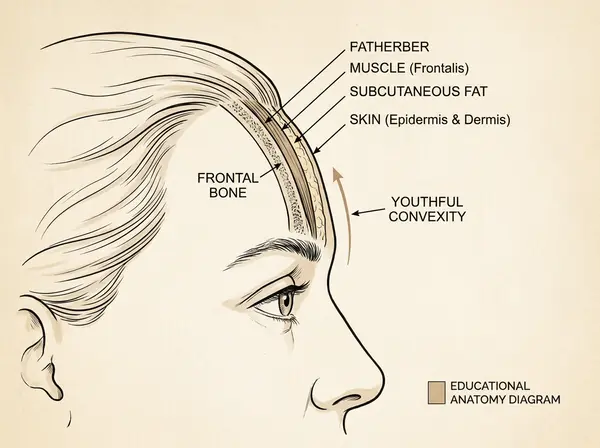
Your forehead's youthful appearance results from specific anatomical characteristics that gradually deteriorate over time:
The Youthful Forehead Profile
In youth, the forehead displays:
Gentle Convexity: A subtle outward curve from hairline to brow ridge, creating soft roundness rather than flatness
Smooth Contours: Minimal visible texture, wrinkles, or irregularity when the face is at rest
Appropriate Projection: The forehead projects slightly forward, balanced proportionally with other facial features
Full Upper Face: Adequate soft tissue volume creating a "filled-out" appearance without hollowness
Minimal Brow Descent: The eyebrows sit at an aesthetically pleasing height without drooping or heaviness
Age-Related Forehead Changes

Multiple processes compromise these characteristics:
Volume Loss: The deep fat pads beneath forehead skin gradually deflate, removing the cushioning that created youthful fullness. This occurs as early as the late 20s-early 30s in some patients. Aesthetic Surgery Journal
Bone Resorption: Your frontal bone (forehead bone) gradually loses density and volume, particularly along the upper forehead and temporal regions. This creates flattening and can make the forehead appear more vertical rather than gently curved.
Soft Tissue Descent: Gravity pulls forehead tissues downward over time, contributing to brow ptosis and upper eyelid heaviness.
Static Wrinkle Formation: Deep horizontal lines across the forehead become "etched in" even when your face is relaxed, representing skin structure breakdown rather than active muscle contraction.
Skin Quality Degradation: Sun damage (particularly relevant in Bakersfield's intense UV environment), collagen loss, and elastin breakdown create crepey texture and laxity.
Muscle-Related Changes: Repetitive frontalis muscle contraction over decades creates permanent creases that persist even after muscle relaxation with Botox.
Understanding which of these factors affects your forehead determines whether filler, Botox, a combination approach, or alternative treatments serve you best.
When Forehead Filler Works Better Than Botox Alone
Botox and filler address fundamentally different problems. Recognizing the distinction helps you invest in treatments that actually work:
Botox Treats Dynamic Wrinkles
Neuromodulators (Botox, Dysport, Xeomin) work by:
- Temporarily relaxing the frontalis muscle
- Preventing muscle contraction that creates horizontal forehead lines
- Smoothing wrinkles visible during facial expressions
- Lasting 3-4 months before requiring maintenance
Botox Limitations: It cannot restore lost volume, fill static wrinkles etched into skin at rest, or recreate youthful forehead convexity.
Filler Treats Volume Loss and Static Changes
Hyaluronic acid filler works by:
- Replacing lost soft tissue volume beneath the skin
- Filling static wrinkles that remain when your face is relaxed
- Restoring youthful forehead convexity and projection
- Creating smooth contours independent of muscle movement
- Lasting 12-18 months (longer than Botox due to less movement in this area)
7 Signs You Need Filler, Not Botox
- Visible Lines at Rest: Your forehead shows deep horizontal wrinkles even when your eyebrows are completely relaxed and you're making no expression.
- Flattened Profile: Your forehead appears flat or concave rather than gently rounded when viewed from the side.
- Volume Loss Above Brows: You notice hollowing or depression in the area just above your eyebrows, creating a "shelf" appearance.
- Temporal Hollowing: The sides of your forehead (temples) appear sunken or concave, creating a gaunt appearance.
- Previous Botox Didn't Fully Work: You've received Botox but still have visible lines or an aged forehead appearance even with muscle relaxation.
- Heaviness Over Eyes: Your forehead's volume loss contributes to brow descent and upper eyelid heaviness that Botox alone can't address.
- Aged Upper Face Proportions: Your forehead has lost the youthful fullness that balanced your other facial features, making your face appear top-heavy or aged.
If three or more apply, forehead filler may provide better results than Botox alone—or the two treatments may work synergistically for optimal improvement.
The Strategic Forehead Filler Approach: Where and How
Proper forehead filler placement requires understanding three-dimensional facial anatomy and avoiding the "pillow head" appearance that results from indiscriminate volume addition:
Treatment Zones
1. Central Forehead (Horizontal Lines)
For deep static wrinkles running horizontally across your forehead:
- Filler placed in the deep dermis or subcutaneous plane
- Small amounts (often <0.5ml total) distributed across multiple injection points
- Creates smooth surface by "filling from beneath" the wrinkle
Technique: Linear threading or serial puncture, depositing tiny amounts of low-to-medium viscosity HA filler along the length of each wrinkle.
2. Upper Forehead (Volume Restoration)
To restore youthful convexity and projection:
- Filler placed deeply (supraperiosteal, directly on bone)
- Larger volumes (1-2ml) for structural support
- Creates gentle outward curve rather than flat profile
Technique: Supraperiosteal bolus placement using robust, cohesive filler that provides structural support without migration.
3. Temporal Hollows (Side Forehead)
For sunken temples creating gaunt appearance:
- Filler placed in multiple planes (deep temporal fat pad, temporal bone)
- Moderate volume (0.5-1ml per side)
- Restores lateral facial width and youthful fullness
Technique: Combination of deep structural support and mid-level volume, often using cannula for safety near temporal artery.
4. Glabellar Region (Between Brows)
For the "11 lines" and volume loss creating frown appearance:
- Very conservative volume (<0.5ml total)
- Precise placement avoiding vascular danger zones
- Often combined with Botox for optimal results
Technique: Extremely cautious injection in this high-risk vascular area, using cannula when possible and aspirating frequently.
Product Selection Matters
Not all fillers work equally well for forehead treatment:
Static Wrinkle Filling: Medium-viscosity HA fillers like Restylane Refyne or Juvéderm Volbella that integrate smoothly without creating lumps
Structural Volume: Robust, cohesive products like Juvéderm Voluma or Restylane Lyft that provide projection and resist migration
Temporal Augmentation: High-cohesivity fillers designed for deep placement and structural support
Dr. Chang's extensive injectable experience means he selects the optimal product for each specific treatment zone rather than using one-size-fits-all filler.
The Critical Difference: Natural Enhancement vs. "Pillow Head"
Perhaps more than any other facial area, the forehead reveals poor technique dramatically:
What Creates Unnatural Results
Excessive Volume: The most common problem—too much filler creating obvious bulging or "Neanderthal brow" appearance
Superficial Placement: Filler placed too close to the surface becomes visible, palpable, and creates lumpy texture
Central Overemphasis: Adding volume only to the center while ignoring temples creates disproportionate width
Ignoring Bone Structure: Failing to work with your natural anatomy and instead imposing generic "fullness"
Dr. Chang's Natural Enhancement Philosophy
Conservative Initial Volume: Starting with minimal effective amount and building gradually over multiple sessions if desired
Proportion-Based Treatment: Ensuring forehead enhancement balances with your mid-face and lower face rather than existing in isolation
Deep Structural Placement: Positioning filler on bone (supraperiosteal) where it provides support without surface visibility
Asymmetry Correction: Using filler to balance naturally asymmetric bone structure rather than simply adding symmetric volume
Integration with Other Treatments: Combining forehead filler with Botox, brow procedures, or mid-face enhancement for comprehensive improvement
The goal isn't "adding volume"—it's "restoring age-appropriate architecture."
Combining Forehead Filler with Botox: The Synergistic Approach
Many patients achieve optimal results by addressing both volume loss (with filler) and dynamic wrinkles (with Botox):
Complementary Benefits
Botox Component:
- Relaxes frontalis muscle preventing new wrinkle formation
- Smooths dynamic lines visible during expressions
- Prevents filler from being "pushed around" by strong muscle contraction
- Extends filler longevity by reducing mechanical stress
Filler Component:
- Fills static wrinkles that remain after muscle relaxation
- Restores youthful convexity and volume
- Addresses bone and soft tissue loss that Botox can't treat
- Provides structural foundation that makes Botox results appear more natural
Treatment Sequencing
Dr. Chang typically recommends:
Option 1 - Botox First:
- Administer Botox to relax forehead muscles
- Wait 2 weeks for full effect
- Assess remaining static concerns
- Add filler strategically to address volume loss and static wrinkles
Advantage: See exactly what Botox alone accomplishes before adding filler
Option 2 - Simultaneous Treatment:
- Administer both Botox and filler in the same appointment
- More efficient for patients with clear dual concerns
- Requires expert assessment to predict combined outcome
Advantage: Single appointment, faster overall results
Option 3 - Filler First:
- Less common but appropriate for some patients
- Address structural volume loss first
- Add Botox later if dynamic wrinkles remain significant
The optimal sequence depends on your specific anatomy, aesthetic goals, and previous treatment history.
High-Risk Vascular Anatomy: Why Expertise Matters
The forehead contains critical blood vessels that, if accidentally injected, can cause serious complications including vision loss, stroke, or tissue death:
Danger Zones
Supratrochlear Artery: Runs vertically in the glabellar region (between brows), supplying blood to forehead skin and connecting to vessels feeding the eyes
Supraorbital Artery: Exits from a notch or foramen in the bone at the medial upper orbital rim, also connecting to ocular blood supply
Frontal Branch of Superficial Temporal Artery: Courses through the temple region, vulnerable during temporal filler injection
Central Forehead Perforators: Small vessels penetrating from deep to superficial tissues throughout the forehead
How Dr. Chang Prevents Vascular Complications
Intimate Anatomical Knowledge: Oculoplastic fellowship training provides surgical-level understanding of forehead vascular anatomy
Conservative Glabellar Approach: Extreme caution (or complete avoidance) in the highest-risk area between brows
Cannula Technique: Using blunt-tipped cannulas rather than needles when appropriate—the blunt tip pushes vessels aside rather than penetrating them
Aspiration Before Injection: Pulling back on the syringe before depositing filler to check for blood vessel placement
Slow Injection with Observation: Injecting gradually while monitoring for early warning signs (pain, skin color change, vision disturbance)
Immediate Access to Hyaluronidase: Having enzyme available to dissolve filler immediately if vascular occlusion occurs
While serious complications are rare with expert technique, the forehead demands the highest level of injectable expertise—not an appropriate treatment for inexperienced injectors regardless of cost savings.
Forehead Filler for Men: Masculine Aesthetic Goals
Approximately 35% of forehead filler patients are men seeking age-appropriate restoration without feminization:
Key Differences in Treating Male Foreheads
Masculine Proportions: Male foreheads are typically broader, higher, and less curved than female foreheads. Treatment must maintain these characteristics.
Straighter Profile: Men generally have flatter forehead profiles than women—overly rounded convexity appears feminine.
Larger Volume Requirements: Male facial structures are proportionally larger, often requiring more filler for noticeable improvement.
Subtlety Prioritized: Male patients typically emphasize professional discretion even more than female patients, wanting improvement without obvious intervention.
Brow Position: Maintaining or emphasizing lower, straighter male brow position rather than the higher arch preferred in female aesthetics.
Dr. Chang's approach for male patients focuses on strength, structure, and age-appropriate restoration rather than "softening" or "smoothing" that might compromise masculine appearance.
Treatment Experience and Recovery
Understanding the actual procedure helps set realistic expectations:
Consultation (30-45 Minutes)
- Comprehensive facial analysis including bone structure, soft tissue volume, skin quality
- Discussion of aesthetic goals and realistic outcomes
- Photography from multiple angles in various lighting
- Treatment planning (filler alone vs. combined with Botox)
- Risk discussion specific to forehead vascular anatomy
Treatment Day (45-60 Minutes)
- Pre-treatment photos
- Topical numbing cream application (15-20 minutes)
- Marking injection points or entry points for cannula
- Precise filler placement according to treatment plan
- Immediate assessment and any necessary adjustments
- Post-treatment photos and aftercare instructions
Sensation: Most patients describe pressure and fullness rather than sharp pain. The forehead is less sensitive than lips but more sensitive than cheeks.
Recovery Timeline
- Immediately: Mild swelling, possible small bruises at injection points, slight tenderness
- Days 1-3: Peak swelling (may appear slightly "overdone" temporarily), possible asymmetry as one side swells more
- Days 4-7: Swelling subsides significantly, emerging results visible
- Week 2: Follow-up assessment, additional refinement if desired
- Months 12-18: Gradual filler metabolism, maintenance appointment scheduled
Most patients return to work the same day or next day. Avoid strenuous exercise, excessive heat, and lying completely flat for 48 hours.
Bakersfield-Specific Considerations

Central Valley lifestyle affects forehead filler outcomes:
Intense Sun Exposure
Bakersfield's UV index regularly reaches "extreme" levels (10+) April through October. Sun damage:
- Accelerates filler breakdown requiring more frequent maintenance
- Worsens skin quality affecting how filler integrates
- Increases inflammation risk post-treatment
Management:
- Daily broad-spectrum SPF 50+ on forehead
- Wide-brim hats during outdoor activities
- Reapplication every 2 hours in sun
- Consider treatment during cooler months (October-March)
Heat and Swelling
Summer temperatures exceeding 100°F can temporarily worsen post-treatment swelling:
- Schedule treatment during cooler seasons if possible
- Avoid extended outdoor exposure first 48-72 hours post-treatment
- Use cool compresses to manage swelling
- Stay well-hydrated
Outdoor Work and Recreation
Agricultural workers, construction professionals, and outdoor enthusiasts should:
- Plan adequate recovery time before extended sun exposure
- Use protective headwear
- Apply extra sun protection during the vulnerable first week
Professional Image Timing
For Bakersfield business professionals:
- Schedule forehead filler 2-3 weeks before important presentations or professional photography
- Allow adequate time for swelling resolution
- Consider conservative volume for maximum discretion
Cost and Investment: Understanding Forehead Filler Pricing
Forehead Filler Cost: $800-$2,500 per treatment session
Pricing factors:
- Volume Required: Central wrinkle filling needs less (0.5-1ml = $800-1,200) than full volume restoration (2-3ml = $1,600-2,500)
- Treatment Zones: Single area (just horizontal lines) vs. comprehensive (forehead + temples)
- Product Type: Premium structural fillers cost more than standard HA products
- Provider Expertise: fellowship-trained specialists charge more than general injectors—but deliver superior safety and results
- Geographic Location: Bakersfield pricing typically lower than California coastal areas
Longevity Consideration: At 12-18 months duration, forehead filler's cost-per-month is reasonable:
- $1,500 treatment ÷ 15 months = $100/month for significantly improved forehead appearance
Combination Pricing: When combined with Botox, many practices (including Modern Aesthetic Institute) offer package pricing that saves compared to separate appointments.
Modern Aesthetic Institute offers financing through CareCredit and Cherry, making treatment accessible with monthly payment options.
Common Forehead Filler Myths and Misconceptions
Myth #1: "Forehead filler will make my head look bigger"
Truth: Properly placed filler restores natural volume rather than creating exaggerated size. Dr. Chang's conservative approach ensures enhancement stays within age-appropriate proportions.
Myth #2: "You can only do Botox on the forehead, not filler"
Truth: While Botox is more common, filler addresses different concerns (volume loss, static wrinkles) that Botox can't treat. Many patients benefit from both.
Myth #3: "Forehead filler is dangerous and causes blindness"
Truth: While vascular complications are possible (as with any facial filler), they're extremely rare with proper technique. Dr. Chang's oculoplastic training and conservative approach minimize risk to near-zero levels.
Myth #4: "I'm too young for forehead filler"
Truth: Forehead volume loss can begin in late 20s-early 30s. Age isn't the determining factor—anatomy is. If you have volume loss creating hollowness or static wrinkles, filler may be appropriate regardless of age.
Myth #5: "Forehead filler looks unnatural"
Truth: Poorly executed forehead filler looks unnatural. Expert placement by an experienced injector creates results that look like "you on a great day" rather than "you with obvious work done."
Questions to Ask During Your Forehead Filler Consultation
- "How many forehead filler treatments do you perform monthly?" (Higher volume suggests more experience with this specific procedure)
- "Which filler product will you use for my forehead and why?" (Should explain product characteristics matched to your treatment zones)
- "What's your approach to preventing vascular complications?" (Should discuss anatomy knowledge, aspiration, cannula use, hyaluronidase availability)
- "Can you show me before-and-after photos of forehead filler patients with similar anatomy?" (Evidence of natural results)
- "Do you recommend combining filler with Botox for my forehead?" (Demonstrates comprehensive assessment rather than one-treatment-fits-all approach)
- "What happens if I'm not satisfied with my results?" (HA filler can be dissolved; good injectors discuss this openly)
- "What's your training background in facial anatomy?" (Surgical training, fellowship education, years of experience all matter)
When Forehead Filler Isn't the Answer
Dr. Chang may recommend against forehead filler if:
- Severe Brow Ptosis: Significant drooping requires surgical brow lift rather than filler
- Minimal Volume Loss: If your forehead concern is purely dynamic wrinkles, Botox alone is more appropriate
- Very Thin Skin: Extremely thin forehead skin may not camouflage filler adequately, creating visible lumps
- Unrealistic Expectations: Desire for dramatic transformation that filler can't safely achieve
- Medical Contraindications: Active infection, autoimmune conditions, or other factors increasing complication risk
- Previous Complications: History of severe reactions, vascular issues, or migration with facial filler
Honest guidance about when not to treat demonstrates commitment to your best interests rather than maximizing procedure volume.
Your Path to Naturally Refreshed Forehead Appearance

Forehead filler offers meaningful rejuvenation for patients whose aging stems from volume loss rather than—or in addition to—dynamic muscle movement. When performed by an expert injector who understands three-dimensional facial anatomy, respects vascular danger zones, and prioritizes natural proportions over generic "fullness," the procedure delivers subtle enhancement that makes you look refreshed, rested, and age-appropriate rather than obviously treated.
Dr. Joseph H. Chang's unique combination of ophthalmology training, oculoplastic fellowship training from UCLA, and 25+ years serving Bakersfield provides the expertise necessary to assess your candidacy accurately, inject safely in this high-risk area, and create results that honor your natural features while addressing age-related changes.
Whether you're considering forehead filler alone, combining it with Botox for comprehensive rejuvenation, or simply seeking education about your options, schedule a consultation at Modern Aesthetic Institute. Discover whether forehead filler can restore the youthful fullness and smooth contours you desire—or whether alternative approaches better serve your specific anatomy and goals.
Schedule Your Forehead Filler Consultation at Modern Aesthetic Institute
About the Author
Dr. Joseph H. Chang is an ophthalmologist specializing in oculoplastic surgery with over 25 years of aesthetic medicine experience serving Bakersfield and Kern County. Trained at UCLA's prestigious Jules Stein Eye Institute, Dr. Chang brings surgical precision and artistic sensibility to every injectable treatment. His 25+ years of injectable experience reflects his expertise and the trust patients place in his care. At Modern Aesthetic Institute, Dr. Chang's philosophy centers on natural enhancement, patient education, and honest guidance—helping you achieve a refreshed, youthful appearance without looking "overdone." His specialized training in oculoplastic surgery provides unique advantages for facial aesthetic treatments, combining intimate anatomical knowledge with years of refined injectable technique.
Frequently Asked Questions
1. Can forehead filler replace Botox, or do I need both?
It depends on your specific concerns. Botox relaxes the frontalis muscle preventing dynamic wrinkles that appear during facial expressions—it's ideal if your forehead looks smooth at rest but wrinkles significantly when you raise your eyebrows. Forehead filler restores lost volume and fills static wrinkles visible even when your face is completely relaxed—it's ideal if you have deep lines at rest, flattened profile, or hollowing. Many patients achieve optimal results with both: Botox preventing new dynamic wrinkles while filler addresses existing volume loss and static lines. During your consultation, Dr. Chang assesses which concerns dominate your aging pattern and recommends the most effective approach—sometimes filler alone, sometimes Botox alone, often a strategic combination of both.
2. How many syringes of filler do I need for forehead treatment?
Most patients require 0.5-2 syringes (0.5-2ml) depending on treatment goals. For filling only horizontal static wrinkles, 0.5-1ml often suffices. For restoring full forehead volume and convexity, 1-2ml provides noticeable improvement. Adding temporal augmentation may require an additional 0.5-1ml per side. Men typically need toward the higher end due to larger facial proportions. Dr. Chang's philosophy is conservative initial treatment—starting with moderate volume and adding more at your two-week follow-up if desired. This staged approach prevents the "overdone" appearance that results from aggressive single-session treatment. Most patients appreciate seeing modest improvement before committing to additional volume.
3. Will forehead filler give me a "Neanderthal" brow or bulging forehead?
Not when performed correctly by an experienced injector. The "Neanderthal brow" or obviously bulging forehead results from: (1) Excessive volume—trying to achieve dramatic transformation rather than age-appropriate restoration, (2) Wrong product—using soft fillers that spread rather than structural products that hold position, (3) Superficial placement—injecting too close to the surface rather than deeply on bone, or (4) Poor anatomical understanding—adding volume without respecting your natural bone structure. Dr. Chang's oculoplastic training provides surgical-level understanding of forehead anatomy. His conservative philosophy prioritizes subtle enhancement that restores youthful convexity without creating unnatural protrusion. Properly placed forehead filler should make you look refreshed and well-rested, not obviously augmented.
4. Is forehead filler dangerous? I've heard horror stories about blindness.
Forehead filler does carry vascular risk due to arteries in this area that connect to vessels supplying the eyes—accidental injection into these vessels can theoretically cause vision loss. However, this complication is extremely rare (estimated <0.001% with proper technique) and nearly always results from inexperienced injectors, excessive volume, or improper technique. Dr. Chang's prevention strategies include: (1) Intimate knowledge of forehead vascular anatomy from oculoplastic fellowship training, (2) Conservative volume avoiding excessive pressure, (3) Cannula technique when appropriate (blunt tip pushes vessels aside), (4) Aspiration before injection to check for vessel placement, (5) Slow injection with constant monitoring for warning signs, and (6) Immediate hyaluronidase availability to dissolve filler if complications arise. Choosing a fellowship-trained specialist with surgical anatomical training is the single most important safety decision you can make.
5. How long does forehead filler last before I need a touch-up?
Forehead filler typically lasts 12-18 months—longer than most facial areas due to less movement in this region. The forehead experiences some expression-related motion but far less than lips, nasolabial folds, or other highly mobile zones. Duration varies based on: (1) Individual metabolism (faster metabolizers require more frequent maintenance), (2) Product used (robust structural fillers last longer than softer products), (3) Volume injected (larger amounts last proportionally longer), (4) Sun exposure (Bakersfield's intense UV accelerates breakdown), and (5) Treatment area (deep structural placement lasts longer than superficial wrinkle filling). Most patients schedule maintenance appointments around 14-16 months to preserve results before complete product metabolism. Some choose to let filler fade completely before re-treating; others prefer maintaining consistent results continuously.
6. Can I exercise or wear a hat after forehead filler?
Avoid strenuous exercise for 48 hours after forehead filler to minimize swelling and bruising risk. Light walking is fine immediately, but skip: heavy weightlifting, high-intensity cardio, hot yoga, or activities significantly increasing facial blood flow and pressure. After 48 hours, gradually resume normal exercise. Regarding hats: avoid tight-fitting hats or headbands for the first 48-72 hours that put direct pressure on treated areas. Loose baseball caps or wide-brim sun hats (important for Bakersfield sun protection!) are fine as long as they don't compress the forehead. Also avoid for 24-48 hours: excessive heat (saunas, hot tubs), alcohol (increases bruising), aggressive massage, and lying completely flat (sleep with head slightly elevated). After the initial 48-72 hours, return to all normal activities including exercise and hat-wearing.
7. I already have Botox in my forehead. Can I still get filler?
Yes—forehead filler works beautifully in combination with Botox, and many patients benefit from both. In fact, having Botox already in place can be advantageous because the relaxed muscle creates less mechanical stress on the filler, potentially extending its longevity. The ideal timing: wait 2 weeks after Botox to assess full muscle relaxation before adding filler, allowing you to see exactly what Botox accomplished and what volume concerns remain. Alternatively, both can be administered in the same appointment if you have clear dual concerns (dynamic wrinkles + volume loss). Dr. Chang coordinates the two treatments strategically, ensuring the combination creates natural, comprehensive rejuvenation. The Botox prevents new dynamic wrinkles while the filler addresses existing static changes and volume depletion—complementary benefits addressing different aspects of forehead aging.
8. Will people be able to tell I've had forehead filler?
When performed expertly with conservative volume, forehead filler creates natural-looking rejuvenation that people notice as "you looking great" rather than "you had work done." The key is appropriate volume for your bone structure and age, deep placement that isn't visible or palpable, and proportion that balances with your overall facial aesthetics. Most patients receive compliments like "you look well-rested," "did you get more sleep?" or "you look refreshed" rather than "did you have something done to your forehead?" Dr. Chang's philosophy prioritizes subtle, age-appropriate enhancement. If you're concerned about discretion, starting with conservative volume allows gradual improvement that friends, family, and colleagues won't pinpoint to a specific procedure. You can always add more filler at follow-up if you desire additional enhancement—but you can't "un-do" excessive volume without dissolution.